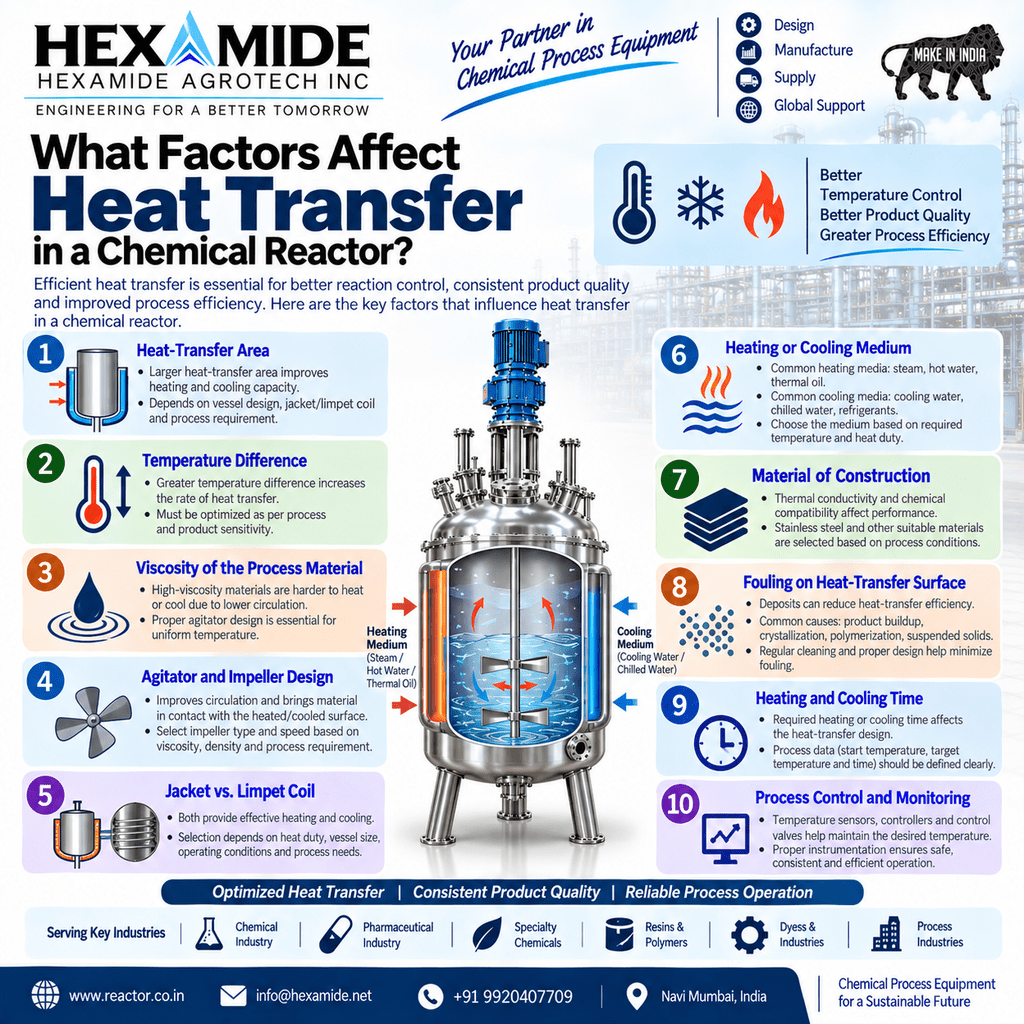
Introduction
Heat transfer is a critical part of many chemical and industrial processes. During a reaction, the process material may need to be heated, cooled, or maintained at a specific temperature for the required reaction conditions.
The performance of the heat-transfer system can directly affect reaction time, product consistency, energy consumption, and overall process efficiency.
Chemical reactors commonly use jackets, limpet coils, or other heat-transfer arrangements to transfer heat between the process material and a heating or cooling medium.
But what determines how effectively heat is transferred?
Let’s look at the key factors.
1. Heat-Transfer Area
The available heat-transfer area is one of the most important factors in reactor design.
A larger effective heat-transfer area can provide greater capacity for transferring heat between the process material and the heating or cooling medium.
The required area depends on factors such as:
- Batch size
- Required heating or cooling duty
- Temperature difference
- Process material properties
- Heating or cooling medium
- Desired heating or cooling time
The heat-transfer area should therefore be determined from the actual process requirement.
2. Temperature Difference
Heat transfer is driven by a temperature difference between the process material and the heating or cooling medium.
For example, during heating, a suitable temperature difference between the heating medium and the process material provides the driving force for heat transfer.
During cooling, the cooling medium must be at a suitable temperature relative to the process material.
However, higher temperature differences are not always appropriate because some products can be temperature-sensitive.
3. Viscosity of the Process Material
Viscosity can have a significant effect on heat transfer.
Low-viscosity liquids can generally circulate more easily inside the reactor, allowing heat to spread through the batch.
High-viscosity materials may circulate more slowly and can create temperature differences within the vessel if the agitation system is not properly designed.
Materials such as resins, polymers, adhesives, and thick formulations may therefore require carefully designed agitation and heat-transfer systems.
4. Agitator and Impeller Design
The agitator does more than simply mix the material.
It also helps move the process material throughout the reactor and brings material into contact with the heated or cooled vessel surface.
The impeller should be selected according to:
- Viscosity
- Density
- Solids content
- Reactor geometry
- Mixing requirement
- Required circulation
- Operating speed
For high-viscosity materials, specialized agitators such as anchor or helical ribbon designs may be considered.
5. Jacket vs. Limpet Coil
Two common external heat-transfer arrangements are jacketed reactors and limpet coil reactors.
A jacket surrounds the vessel shell and allows heating or cooling media to circulate around the vessel.
A limpet coil consists of an external coil welded around the vessel shell through which the heating or cooling medium flows.
The choice between the two should be based on the required heat-transfer duty, vessel size, operating conditions, available heat-transfer area, and process requirements.
6. Heating or Cooling Medium
The selection of heating or cooling medium also affects reactor performance.
Common heating media include:
- Steam
- Hot water
- Thermal oil
Common cooling media include:
- Cooling water
- Chilled water
- Refrigerated fluids
The appropriate medium depends on the required process temperature and heat-transfer duty.
7. Material of Construction
The reactor material can also influence the overall heat-transfer design.
Materials commonly considered for chemical process equipment include stainless steels and other materials selected according to chemical compatibility and operating conditions.
The material must be suitable for the process chemistry as well as the expected temperature, pressure, and cleaning conditions.
8. Fouling on the Heat-Transfer Surface
Deposits or fouling on the heat-transfer surface can reduce heat-transfer performance.
Fouling may occur because of:
- Product buildup
- Polymerization
- Crystallization
- Chemical deposits
- Suspended solids
Process design and cleaning procedures should therefore consider the possibility of fouling, particularly for processes where material can accumulate on the vessel wall.
9. Heating and Cooling Time
The required heating or cooling time is an important design parameter.
A process requiring rapid temperature changes may need a different heat-transfer arrangement from a process where gradual heating or cooling is acceptable.
The manufacturer should know the required:
Starting temperature → Target temperature → Required time
This information helps in evaluating the heat-transfer requirement.
10. Process Control and Temperature Monitoring
Good heat transfer should be combined with appropriate process control.
Temperature sensors can be used to monitor the process temperature and help control heating or cooling.
Depending on the application, the system may include:
- Temperature sensors
- Temperature controllers
- Control valves
- Heating systems
- Cooling systems
- Automated control systems
Proper instrumentation can help maintain the desired process temperature more consistently.
How to Improve Heat Transfer in a Chemical Reactor
Several factors can be optimized together to improve reactor heat-transfer performance:
- Provide adequate heat-transfer area.
- Select the appropriate jacket or limpet coil configuration.
- Choose a suitable heating or cooling medium.
- Select the agitator according to process viscosity.
- Maintain effective circulation inside the vessel.
- Minimize unwanted fouling.
- Provide suitable temperature measurement and control.
- Design the reactor according to the actual process heat load.
Heat-transfer performance should always be evaluated as part of the complete reactor design.
Conclusion
Effective heat transfer is essential for many chemical reactor applications. The performance of a reactor heating or cooling system depends on several factors, including heat-transfer area, temperature difference, process viscosity, agitation, reactor configuration, heating or cooling medium, material of construction, and fouling characteristics.
A jacketed reactor or limpet coil reactor should therefore be selected based on the specific process rather than simply choosing a standard configuration.
At Hexamide Agrotech Inc, reactor and process equipment designs can be developed according to application-specific requirements, including heating, cooling, mixing, capacity, material of construction, and operating conditions.