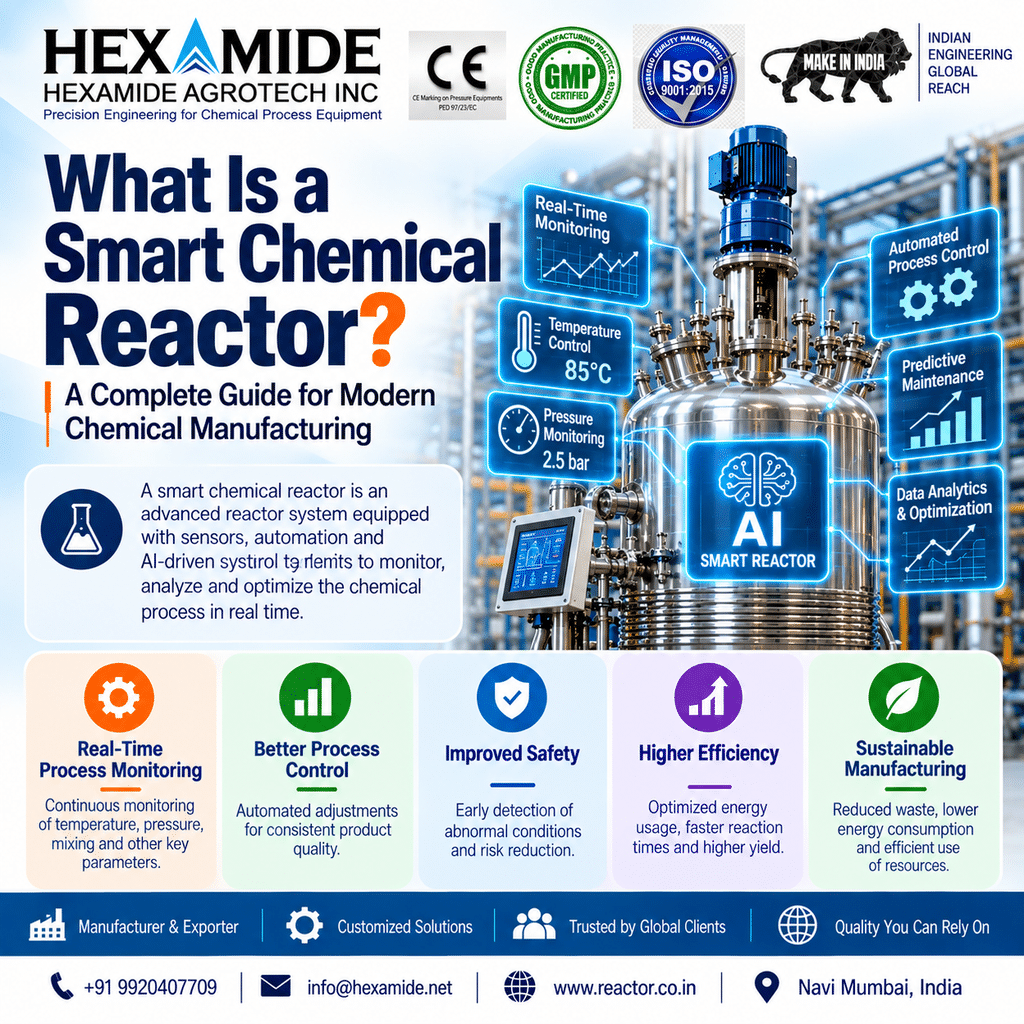
Chemical manufacturing is rapidly moving toward automation, real-time monitoring, data-driven decision-making, and energy-efficient production. One of the important developments in this transformation is the Smart Chemical Reactor.
A smart chemical reactor combines a conventional reactor vessel with sensors, instrumentation, automated controls, data monitoring, and advanced process analytics. This allows manufacturers to monitor critical process parameters and respond more quickly to changes during production.
For chemical, pharmaceutical, specialty chemical, resin, and other process industries, smart reactor technology can improve process consistency, safety, energy management, productivity, and equipment reliability.
In this guide, we explain what a smart chemical reactor is, how it works, its major components, benefits, applications, and what manufacturers should consider before implementing smart reactor technology.
What Is a Smart Chemical Reactor?
A Smart Chemical Reactor is a chemical reaction vessel equipped with digital instrumentation and control systems that allow important process parameters to be monitored and, where appropriate, automatically controlled.
A conventional chemical reactor may rely heavily on operator observation and manually adjusted valves or controls.
A smart reactor can continuously collect information such as:
- Temperature
- Pressure
- Agitator speed
- Torque
- pH
- Level
- Flow rate
- Heating and cooling conditions
- Vacuum
- Feed addition rate
- Motor load
- Reaction time
This information can be displayed through a PLC, HMI, SCADA system, DCS, or other digital process-control platform.
The objective is not simply to add more sensors. The real value comes from using process data to understand, control, optimize, and document the reaction more effectively.
How Does a Smart Chemical Reactor Work?
A smart reactor typically operates through four main stages:
1. Data Collection
Sensors installed on the reactor continuously measure important process parameters.
For example, temperature sensors can measure the reaction temperature at different stages of the batch.
2. Data Processing
The collected information is transferred to a PLC, DCS, SCADA, or another control system.
The system can compare actual process conditions with predefined operating parameters.
3. Automated Control
Based on the programmed process logic, the control system can regulate equipment such as:
- Heating systems
- Cooling systems
- Agitator drives
- Pumps
- Control valves
- Vacuum systems
- Material dosing systems
4. Monitoring and Analysis
Operators can view process information through an HMI or SCADA screen.
Historical data can also help identify process deviations, equipment problems, and opportunities for optimization.
Key Components of a Smart Chemical Reactor
A smart reactor is not necessarily a completely different type of reactor vessel. In many cases, a conventional jacketed reactor, limpet coil reactor, or stainless steel reaction vessel can be integrated with suitable instrumentation and automation.
Important components may include:
1. Temperature Sensors
Temperature is one of the most important parameters in chemical reactions.
RTDs, thermocouples, or other temperature sensors can continuously monitor the reaction temperature.
Temperature data can be used to control:
- Steam heating
- Hot-water circulation
- Thermal-oil heating
- Chilled-water cooling
- Brine cooling
- Other heating/cooling systems
Accurate temperature control is particularly important for reactions that are highly temperature-sensitive.
2. Pressure and Vacuum Measurement
Pressure transmitters, vacuum gauges, and pressure switches can monitor reactor operating conditions.
This can be particularly useful for:
- Vacuum reactions
- Distillation
- Solvent recovery
- Pressure reactions
- Evaporation processes
Suitable pressure-relief and safety systems must still be provided according to the applicable process and equipment requirements.
3. Automated Agitator Control
Mixing performance has a major effect on many chemical reactions.
A smart reactor can use a VFD-controlled agitator to adjust speed according to the process requirement.
For example:
Low-speed mixing → gentle blending
Medium-speed mixing → suspension and uniform mixing
High-speed mixing → dispersion or intensified mixing where appropriate
The actual agitator and impeller selection must be based on process requirements rather than simply increasing RPM.
4. Flow and Dosing Control
Raw materials can be added using controlled pumps, flowmeters, load cells, or automated dosing systems.
This can improve consistency when precise addition rates are important.
For example, a recipe may require:
Add Material A at a controlled rate while maintaining the reactor between specified temperature limits.
An automated system can coordinate these operations while recording the process data.
Smart Temperature Control in Chemical Reactors
Temperature control is one of the most useful applications of reactor automation.
A jacketed reactor or limpet coil reactor can be connected to a heating or cooling system.
The control system can continuously compare:
Actual temperature → Set temperature
If the reactor temperature falls below the set point, the heating system can respond.
If the temperature rises above the desired range, cooling can be initiated.
A properly designed PID control system can help maintain stable temperature conditions rather than relying entirely on manual valve operation.
However, the effectiveness of temperature control also depends on:
- Reactor geometry
- Heating/cooling surface area
- Heat-transfer coefficient
- Agitation
- Product viscosity
- Batch size
- Heating/cooling medium
- Insulation
- Reaction characteristics
Therefore, automation cannot compensate for an inadequately designed heat-transfer system.
Smart Monitoring of Agitation and Mixing
Mixing is another area where digital monitoring can provide useful information.
Depending on the reactor design, manufacturers can monitor parameters such as:
- Agitator RPM
- Motor current
- Motor load
- Torque
- Mixing time
- Vibration
- Temperature distribution
Changes in motor load or torque may indicate changes in product viscosity or other process conditions.
For example, during a resin manufacturing process, viscosity can change significantly as the reaction progresses. Monitoring motor load can provide additional information about what is happening inside the reactor.
Predictive Maintenance for Chemical Reactors
One potential advantage of connected process equipment is the ability to identify equipment problems before they become major failures.
For example, historical operating data may reveal changes in:
- Motor current
- Bearing temperature
- Vibration
- Agitator torque
- Seal performance
- Pump performance
A maintenance team can investigate unusual trends before equipment failure causes significant production downtime.
This approach is commonly known as predictive maintenance.
However, predictive maintenance requires reliable sensors, good-quality historical data, appropriate analysis, and qualified engineering interpretation.
Smart Reactors and Energy Efficiency
Energy consumption is an important consideration in chemical manufacturing.
Heating and cooling can represent a significant part of the energy required for a batch process.
A smart reactor system can help manufacturers understand:
- How much heating energy is being used
- How long heating takes
- How quickly the batch cools
- When cooling demand peaks
- Whether the reactor is operating outside expected conditions
- Whether process parameters are consistent between batches
This information can help engineers identify opportunities for improving heat transfer, insulation, process scheduling, and utility consumption.
Smart Chemical Reactor vs Conventional Reactor
| Parameter | Conventional Reactor | Smart Chemical Reactor |
|---|---|---|
| Temperature monitoring | Basic/Manual | Continuous digital monitoring |
| Agitator control | Manual or basic VFD | Automated/recipe-based control |
| Data recording | Limited | Continuous data logging |
| Process monitoring | Operator dependent | HMI/SCADA/DCS monitoring |
| Alarm management | Basic | Configurable alarms |
| Batch traceability | Limited | Digital records possible |
| Predictive maintenance | Limited | Data-driven monitoring possible |
| Process optimization | Manual analysis | Historical data and analytics |
| Integration | Standalone | Can integrate with plant systems |
A smart reactor does not automatically mean a fully autonomous reactor. The level of automation can be designed according to the process, budget, safety requirements, and production objectives.
Can AI Be Used With a Smart Chemical Reactor?
Yes. AI and advanced analytics can potentially be integrated with smart reactor systems.
For example, historical process data can be analyzed to identify relationships between:
Temperature + Agitation + Feed Rate + Reaction Time → Product Performance
AI or machine-learning models may help identify process patterns, detect anomalies, or support process optimization.
However, AI should be treated as an engineering support tool, not as a replacement for process engineering, safety systems, or operator oversight.
For critical chemical processes, AI recommendations should be properly validated before being used for automated control.
Applications of Smart Chemical Reactors
Smart reactor technology can be considered for many industries, including:
Chemical Industry
For chemical synthesis, neutralization, reaction, blending, and controlled heating/cooling processes.
Pharmaceutical Industry
For applications requiring accurate process control and batch documentation.
Specialty Chemicals
For reactions where consistency and precise process conditions are important.
Resin Manufacturing
For monitoring temperature, agitation, reaction time, and other important parameters.
Agrochemical Manufacturing
For controlled chemical reactions and formulation processes.
Paints and Coatings
For controlled mixing, dispersion, and temperature management.
Oil & Lubricant Industry
For blending and temperature-controlled processing.
Biotechnology
For applications involving controlled temperature, agitation, and process monitoring.
What Makes a Reactor Truly “Smart”?
Simply installing a temperature sensor does not necessarily make a reactor smart.
A more complete smart reactor solution may include:
Sensors → PLC/DCS → HMI/SCADA → Data Logging → Alarms → Process Analysis → Optimization
The level of sophistication can vary significantly.
For example:
Level 1 – Basic Automation
Temperature indicator + digital control + VFD.
Level 2 – Process Automation
PLC + HMI + automatic heating/cooling + agitator control.
Level 3 – Connected Reactor
PLC/SCADA + historical data + batch records + alarms + remote monitoring.
Level 4 – Advanced Smart Reactor
Connected process equipment + advanced analytics + predictive maintenance + AI-assisted optimization.
Not every manufacturing process requires Level 4 automation. The appropriate level depends on the process and business requirements.
How to Select a Smart Chemical Reactor
Before selecting or designing a smart reactor, manufacturers should evaluate:
1. Reaction Characteristics
Understand reaction temperature, pressure, viscosity, heat release, and reaction time.
2. Material of Construction
Select the appropriate MOC based on:
- Chemicals involved
- Concentration
- Temperature
- Pressure
- Corrosion conditions
- Cleaning requirements
Stainless steel grades such as SS 304 and SS 316L are common in many applications, but material selection should always be based on actual process chemistry.
3. Heating and Cooling Requirements
Determine whether the reactor requires:
- Jacket
- Limpet coil
- Half-pipe coil
- External heat exchanger
- Electrical heating
- Thermal oil
- Steam
- Chilled water
4. Agitation Requirements
Impeller selection should consider:
- Viscosity
- Density
- Solid content
- Gas dispersion
- Desired mixing time
- Shear requirements
5. Automation Level
Determine whether you need:
- Manual operation
- Semi-automatic operation
- PLC-based automation
- SCADA
- Batch recipe management
- Advanced analytics
Benefits of Smart Chemical Reactors
When properly designed and implemented, smart reactor systems can provide several operational advantages:
Better Process Consistency
Automated control can reduce variations caused by manual operation.
Improved Monitoring
Operators can see important process parameters in real time.
Better Batch Documentation
Process data can be recorded for future reference and analysis.
Improved Energy Management
Heating and cooling performance can be analyzed using historical data.
Faster Troubleshooting
Historical trends can help engineers investigate process deviations.
Predictive Maintenance Opportunities
Equipment data can help identify abnormal operating patterns.
Improved Production Visibility
Management and process engineers can obtain better visibility into production performance.
The Future of Chemical Reactor Technology
The future of chemical process equipment is moving toward greater connectivity between mechanical equipment, instrumentation, automation, and data analytics.
Chemical reactors are increasingly being designed not only as pressure vessels or reaction vessels but as part of a larger process-control ecosystem.
The combination of:
Smart Sensors + Automation + Data + Process Engineering + AI
can provide manufacturers with new opportunities to improve production efficiency and process understanding.
However, the foundation remains the same: a smart system cannot compensate for poor reactor design, unsuitable materials, inadequate heat-transfer area, incorrect agitator selection, or poor process engineering.
Conclusion
A Smart Chemical Reactor is essentially a chemical reactor enhanced with instrumentation, automation, digital monitoring, and data capabilities.
It can continuously monitor important parameters such as temperature, pressure, agitation, flow, level, and process conditions, while automation systems can help control heating, cooling, mixing, dosing, and other operations.
For modern chemical manufacturers, smart reactor technology can support better process consistency, improved monitoring, energy management, maintenance planning, and data-driven process optimization.
The most effective solution is not necessarily the most automated one. The right smart reactor is the one where reactor design, process requirements, instrumentation, automation, and safety systems are engineered together.
Why Choose Hexamide Agrotech Inc.?
Hexamide Agrotech Inc. specializes in the design and manufacturing of Chemical Reactors, Stainless Steel Reactors, Jacketed Reactors, Limpet Coil Reactors, Reaction Vessels, Mixing Tanks, Blending Tanks, and other chemical process equipment.
Our approach combines equipment manufacturing with practical process-engineering considerations to develop solutions suitable for chemical and process industries.
Website: www.reactor.co.in
Email: info@hexamide.net
Contact: +91 9920407709
Location: Navi Mumbai, Maharashtra, India