
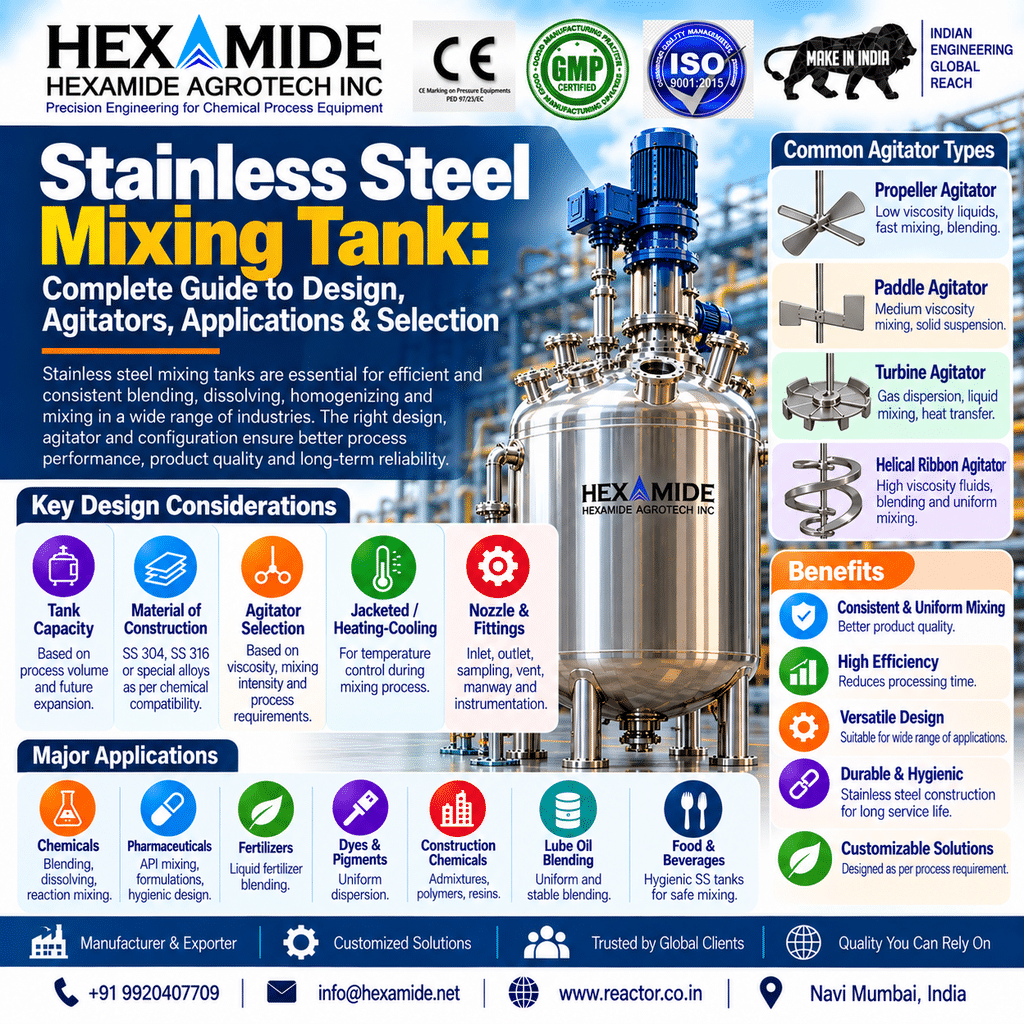
A Stainless Steel Mixing Tank is an important piece of process equipment used for blending, dissolving, dispersing, homogenizing, and preparing liquids, slurries, and other process materials.
In chemical manufacturing, choosing the correct mixing tank is not simply a matter of selecting a tank capacity. The material of construction, agitator type, mixing speed, viscosity, heating or cooling requirements, operating pressure, and process characteristics all influence the final design.
Stainless steel mixing tanks are widely used in chemical, pharmaceutical, specialty chemical, resin, paint, lubricant, food, cosmetic, and other processing industries. Current industrial offerings commonly use SS 304, SS 316 or SS 316L construction and can be configured with different agitators and heating/cooling arrangements.
In this guide, we explain how stainless steel mixing tanks work, how to select the right agitator, and what to consider before purchasing or manufacturing a mixing tank.
What Is a Stainless Steel Mixing Tank?
A stainless steel mixing tank is a process vessel designed to combine two or more materials to achieve a consistent mixture.
Depending on the application, the tank can be supplied with:
- Agitator
- Gearbox
- Electric motor
- VFD
- Heating jacket
- Limpet coil
- Insulation
- Temperature sensor
- Level indicator
- Pressure/vacuum connections
- Manhole
- Charging nozzles
- Drain arrangement
The configuration is customized according to the process requirements.
Why Use Stainless Steel for a Mixing Tank?
Stainless steel is widely used for process equipment because it can provide a combination of corrosion resistance, mechanical durability, cleanability, and suitability for many industrial processes.
Common grades include:
SS 304
Often considered for general-purpose applications where the process chemistry is compatible with the material.
SS 316
May be selected where improved corrosion resistance is required compared with conventional SS 304.
SS 316L
The low-carbon grade is commonly considered for applications where welding characteristics, corrosion resistance, and hygienic requirements are important.
Important: The correct MOC should always be selected based on the actual chemicals, concentration, temperature, pressure, cleaning chemicals, and operating conditions.
How Does a Stainless Steel Mixing Tank Work?
The basic operating principle is straightforward:
Raw Material Charging
↓
Agitator Starts
↓
Mixing / Blending / Dissolution
↓
Heating or Cooling if Required
↓
Process Monitoring
↓
Homogeneous Product
↓
Discharge
However, achieving good mixing depends on the engineering of the complete system.
The tank geometry, impeller, agitator speed, liquid properties, baffles, operating volume, and motor power all influence mixing performance.
Choosing the Right Agitator for a Mixing Tank
The agitator is one of the most important components of an industrial mixing tank.
Different processes require different mixing patterns.
1. Propeller Agitator
Propeller-type agitators can be suitable for relatively low-viscosity liquids where strong circulation is required.
They are commonly considered for:
- Liquid blending
- Low-viscosity solutions
- Circulation applications
2. Paddle Agitator
Paddle agitators can provide relatively gentle mixing and may be suitable for certain low- to medium-viscosity applications.
3. Turbine Agitator
Turbine impellers can provide higher mixing intensity and are used in various industrial processes depending on the required flow pattern and shear.
4. Anchor Agitator
Anchor agitators are often considered for medium- to high-viscosity materials.
They can provide close-clearance movement near the vessel wall and can be useful where wall heat transfer and bulk circulation are important.
5. High-Shear Mixer
High-shear mixing systems are used where the process requires intense dispersion, emulsification, or particle-size reduction.
They are commonly considered for applications such as:
- Emulsions
- Dispersions
- Coatings
- Adhesives
- Specialty chemicals
Why Viscosity Matters in Mixing Tank Design
Viscosity is one of the most important parameters when selecting an agitator.
A low-viscosity liquid generally requires a different mixing arrangement from a highly viscous resin or paste.
As viscosity increases:
- Mixing resistance increases
- Motor torque requirements can increase
- Heat transfer may become more difficult
- Mixing time may increase
- Dead zones may develop
Therefore, the agitator should be selected based on the complete viscosity range of the product, not only its initial viscosity.
Jacketed Stainless Steel Mixing Tank
Some mixing processes require temperature control.
A jacketed stainless steel mixing tank can provide heating or cooling through a jacket surrounding the vessel.
Possible heating/cooling media include:
- Steam
- Hot water
- Thermal oil
- Cooling water
- Chilled water
- Brine
Jacket configuration should be selected according to the required heat-transfer duty, pressure, temperature, vessel geometry, and process conditions.
Limpet Coil Mixing Tank
A stainless steel mixing tank can also be equipped with a limpet coil for heating or cooling.
A limpet coil is fabricated around the tank shell and provides a heat-transfer surface for circulating the selected utility.
This arrangement may be considered for various industrial applications, particularly where the required heat-transfer configuration and fabrication arrangement make it suitable.
The choice between a jacket and limpet coil should be made through process and heat-transfer calculations rather than by tank capacity alone.
VFD-Controlled Stainless Steel Mixing Tank
A Variable Frequency Drive (VFD) allows the agitator speed to be adjusted according to process requirements.
For example:
Charging: Low RPM
Blending: Medium RPM
Dispersion: Higher RPM where appropriate
Final homogenization: Process-specific RPM
Variable-speed operation can provide greater flexibility than running an agitator at a single fixed speed.
However, higher speed does not necessarily mean better mixing. Excessive speed can increase power consumption, shear, vortex formation, or product degradation depending on the process.
Stainless Steel Mixing Tank for Chemical Industry
Chemical manufacturers use mixing tanks for a wide range of processes, including:
- Chemical solution preparation
- Liquid blending
- Neutralization
- Dissolution
- Dispersion
- Suspension
- Formulation
- Resin processing
- Paint mixing
- Adhesive production
- Specialty chemical processing
The exact tank design should be determined by the chemical properties and operating conditions.
Stainless Steel Mixing Tank for Resin Manufacturing
Resin processing can be particularly demanding because viscosity can increase considerably during production.
A resin mixing tank may require:
- High-torque agitator
- Anchor or specialized impeller
- Heating/cooling arrangement
- Temperature monitoring
- Suitable mechanical seal
- Robust gearbox
- Appropriate motor sizing
The agitator should be designed for the expected viscosity and torque throughout the complete batch cycle.
Stainless Steel Mixing Tank for Pharmaceutical Applications
Pharmaceutical processes can place additional emphasis on:
- Cleanability
- Surface finish
- Material traceability
- Drainability
- Hygienic design
- Controlled processing
Depending on the application, stainless steel mixing vessels may be designed with specialized surface finishes and cleaning arrangements.
The exact hygienic and regulatory requirements should be defined according to the intended process and applicable standards.
Stainless Steel Mixing Tank for Paints and Coatings
Paint and coating formulations can involve pigments, fillers, solvents, resins, and additives.
Depending on the formulation, the equipment may require:
- High-speed disperser
- Anchor agitator
- High-shear mixing
- Scraper arrangement
- Multiple agitators
The appropriate design depends on viscosity, solids concentration, shear requirement, and desired dispersion quality.
Stainless Steel Mixing Tank for Lubricants
Mixing tanks are also used for:
- Lubricant blending
- Oil blending
- Additive incorporation
- Formulation
- Temperature-controlled blending
For lubricant applications, the agitator should provide sufficient circulation without unnecessarily increasing energy consumption or introducing unwanted air.
How to Select the Right Stainless Steel Mixing Tank
Before ordering a mixing tank, prepare the following information.
1. Tank Capacity
Specify:
- Total volume
- Working volume
- Minimum operating volume
- Maximum operating volume
2. Product Details
Provide:
- Product name
- Density
- Viscosity
- Solid content
- Temperature
- Chemical composition
3. Mixing Requirement
Define:
- Mixing purpose
- Required mixing time
- Desired homogeneity
- Shear requirement
- Suspension requirement
4. Heating/Cooling Requirement
Specify:
- Heating requirement
- Cooling requirement
- Required temperature range
- Heating/cooling medium
5. Operating Conditions
Define:
- Atmospheric operation
- Vacuum operation
- Pressurized operation
- Operating temperature
6. Material of Construction
Specify the required MOC based on actual process chemistry.
7. Agitator
The agitator should be selected based on:
- Viscosity
- Density
- Tank diameter
- Liquid height
- Mixing duty
- Required flow pattern
Common Mistakes When Selecting a Mixing Tank
Choosing the Tank Only by Capacity
A 5 KL tank does not tell the manufacturer enough information to design the mixing system.
Selecting an Agitator Based Only on RPM
RPM alone does not determine mixing performance.
Ignoring Viscosity Changes
A product may start as a low-viscosity liquid and become highly viscous during processing.
Oversizing the Motor
An oversized motor may increase capital and operating costs without improving the process.
Ignoring Heat Transfer
For temperature-sensitive processes, mixing and heat transfer should be considered together.
Selecting MOC Without Chemical Compatibility
SS 304 or SS 316 should not be selected simply because they are common materials. Compatibility must be evaluated for the actual process.
Stainless Steel Mixing Tank vs Stainless Steel Reactor
Although the terms are sometimes used interchangeably, the equipment can have different primary purposes.
| Feature | Mixing Tank | Chemical Reactor |
|---|---|---|
| Primary purpose | Mixing/blending | Chemical reaction |
| Agitation | Usually required | Usually required |
| Heating/cooling | Optional or required | Frequently important |
| Pressure | Often atmospheric | May be pressurized/vacuum |
| Reaction control | Usually limited | Important |
| Process complexity | Application-dependent | Often higher |
| Automation | Optional/advanced | Often important |
A mixing tank can also be designed for reaction duties when the process requires it.
Smart Mixing Tanks and Automation
Modern mixing tanks can be integrated with digital controls.
Possible instrumentation includes:
- Temperature sensors
- Level sensors
- Pressure gauges
- Flowmeters
- Load cells
- RPM monitoring
- Motor current monitoring
- PLC
- HMI
- SCADA
This can help operators monitor the process and improve repeatability between batches.
For larger manufacturing operations, historical process data can also support maintenance and process optimization.
Benefits of a Properly Designed SS Mixing Tank
A properly engineered stainless steel mixing tank can provide:
Uniform Mixing
Appropriate agitator design can improve product consistency.
Corrosion Resistance
Suitable stainless steel construction can provide durability in compatible chemical environments.
Temperature Control
Jackets or coils can facilitate heating and cooling where required.
Process Flexibility
VFDs and interchangeable process configurations can provide greater operating flexibility.
Easier Cleaning
Appropriate vessel geometry and surface finish can facilitate cleaning.
Customization
Tanks can be designed according to specific capacity, mixing, heating, cooling, pressure, and automation requirements.
Why Custom Engineering Matters
There is no single agitator or tank configuration that is ideal for every application.
For example:
Low-viscosity liquid → Propeller / turbine-type solution
Medium-viscosity product → Paddle / turbine / suitable axial-flow arrangement
High-viscosity product → Anchor / helical / high-torque arrangement
Emulsion or dispersion → High-shear system
These are general examples. Final agitator selection should be based on process calculations and testing where necessary.
Conclusion
A Stainless Steel Mixing Tank is more than a vessel fitted with a motor and agitator.
The tank must be engineered around the actual process—including capacity, viscosity, density, chemical compatibility, mixing duty, temperature, heating/cooling requirements, pressure, and required production cycle.
The right combination of stainless steel construction, agitator design, motor/gearbox, heat-transfer system, instrumentation, and automation can help manufacturers achieve reliable and consistent mixing.
For chemical manufacturers looking to purchase a new mixing tank or upgrade an existing system, a detailed process specification is the best starting point.
Stainless Steel Mixing Tank Manufacturer in India
Hexamide Agrotech Inc. manufactures and supplies industrial Stainless Steel Mixing Tanks, Liquid Mixing Tanks, Agitated Mixing Vessels, Blending Tanks, Jacketed Mixing Tanks, and process equipment for chemical and allied industries.
Our mixing equipment can be engineered according to application-specific requirements including capacity, MOC, agitator configuration, heating/cooling, viscosity, and process conditions.
Hexamide Agrotech Inc.
📍 Navi Mumbai, Maharashtra, India
🌐 www.reactor.co.in
📧 info@hexamide.net
📞 +91 9920407709