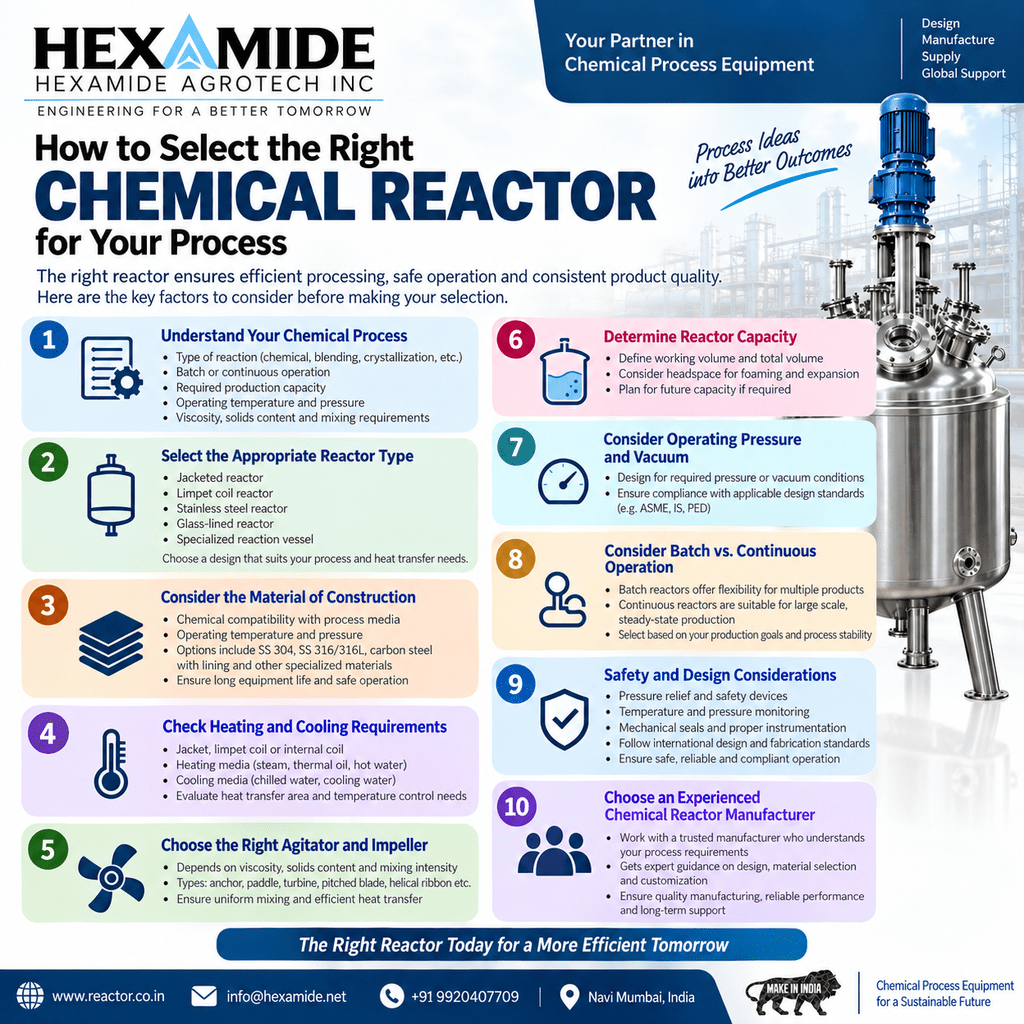
Selecting the right chemical reactor is essential for achieving efficient mixing, controlled temperature, safe operation, and consistent product quality. The ideal reactor depends on several factors, including the type of chemical reaction, operating temperature and pressure, material compatibility, batch size, viscosity, mixing requirements, and heat-transfer requirements.
For chemical, pharmaceutical, fertilizer, dye, resin, and other process industries, choosing the correct reactor design can significantly affect production efficiency, operating costs, and product quality.
In this guide, we explain the key factors to consider when selecting a chemical reactor for your process.
Understand Your Chemical Process
Before selecting a reactor, evaluate whether the process involves a chemical reaction, dissolution, blending, crystallization, polymerization, neutralization, or another operation.
Important process parameters include:
- Type of chemical reaction
- Batch or continuous operation
- Required production capacity
- Reaction time
- Operating temperature
- Operating pressure or vacuum
- Viscosity of the material
- Solid or liquid content
- Heat generation or heat absorption
- Required mixing intensity
A clear understanding of these parameters helps determine the appropriate reactor configuration, agitation system, heating or cooling arrangement, and material of construction.
Select the Appropriate Reactor Type
Different processes require different reactor designs. Common industrial reactor configurations include jacketed reactors, limpet coil reactors, stainless steel reactors, glass-lined reactors, and specialized reaction vessels.
Jacketed Chemical Reactor
A jacketed reactor has an external jacket surrounding the vessel through which heating or cooling media can circulate. It is commonly used when accurate temperature control is important.
Limpet Coil Reactor
A limpet coil reactor uses an external coil welded around the vessel for heating or cooling. It can be suitable for processes requiring efficient heat transfer and specific heating or cooling arrangements.
Stainless Steel Reactor
Stainless steel reactors are widely used in chemical and pharmaceutical processing because stainless steel can provide good corrosion resistance, mechanical strength, cleanability, and compatibility with many process materials.
The final reactor selection should always be based on the actual process conditions and chemical compatibility rather than selecting a reactor type based only on capacity.
Consider the Material of Construction
The material of construction (MOC) is one of the most important considerations when selecting a chemical reactor.
The reactor material must be compatible with the chemicals being processed, operating temperature, pressure, and cleaning conditions. Depending on the application, materials such as stainless steel 304, stainless steel 316/316L, carbon steel with suitable lining, or other specialized materials may be considered.
Chemical compatibility should be evaluated carefully because an unsuitable material can result in corrosion, contamination, leakage, reduced equipment life, and safety problems.
For corrosive chemicals, the process conditions and concentration should be reviewed by a qualified process or materials engineer before finalizing the reactor MOC.
Choosing the Right Chemical Reactor
Choosing the right chemical reactor requires a complete understanding of the process, chemical compatibility, operating conditions, mixing requirements, heat-transfer requirements, capacity, and safety considerations.
There is no single reactor design suitable for every application. A properly selected reactor can provide better temperature control, efficient mixing, reliable operation, improved product consistency, and longer equipment life.
For this reason, it is important to work with an experienced chemical reactor manufacturer that can understand your process requirements and recommend a suitable reactor configuration.
Hexamide Agrotech Inc specializes in the design and manufacture of chemical reactors, stainless steel reactors, jacketed reactors, limpet coil reactors, reaction vessels, mixing tanks, and other chemical process equipment for industrial applications.