Introduction
Selecting the right chemical reactor is an important decision for any chemical processing plant. The reactor must provide effective mixing, controlled heating or cooling, chemical compatibility, and safe operation under the required process conditions.
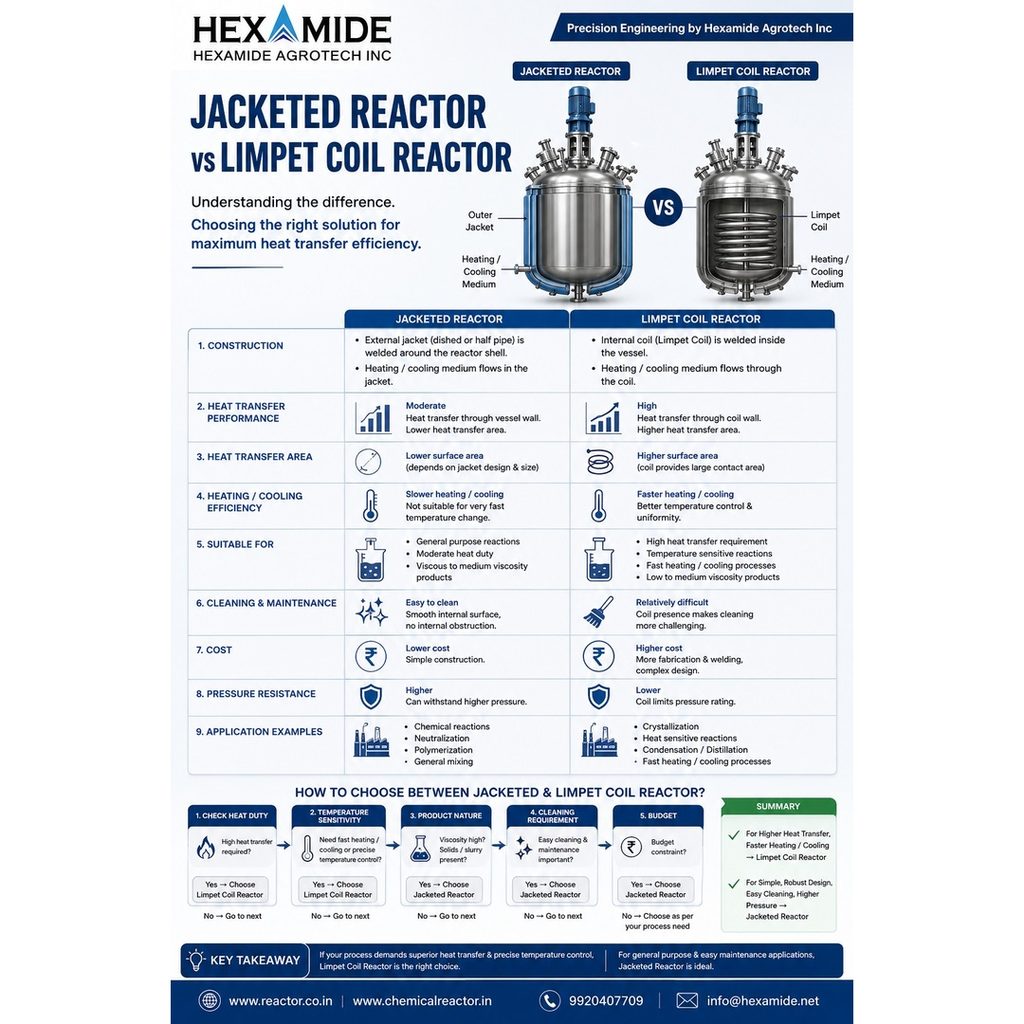
Two commonly used reactor configurations are the Jacketed Reactor and the Limpet Coil Reactor. Both can be designed for heating and cooling applications, but their heat-transfer arrangements, construction, operating characteristics, and suitability for different processes can vary.
Understanding the difference between a jacketed reactor and a limpet coil reactor can help process engineers select a vessel that better matches their production requirements.
What Is a Jacketed Reactor?
A jacketed reactor is a reaction vessel fitted with an external jacket around the vessel shell. Heating or cooling media is circulated through the jacket to transfer heat to or from the process material inside the reactor.
Depending on the application, the jacket may use media such as:
- Steam
- Hot water
- Chilled water
- Thermal oil
- Cooling water
The reactor can also be equipped with an agitator and suitable impeller to maintain uniform mixing and improve heat distribution throughout the batch.
Jacketed reactors are widely used in chemical, pharmaceutical, specialty chemical, resin, dye, and other process industries.
What Is a Limpet Coil Reactor?
A limpet coil reactor uses an external semi-circular or spiral coil welded around the outside of the reactor vessel. Heating or cooling fluid flows through the coil to provide indirect heat transfer.
The limpet coil can be designed according to the required heat-transfer area, operating conditions, and vessel dimensions.
Like a jacketed reactor, a limpet coil reactor can be fitted with an agitator, mechanical seal, temperature sensors, pressure connections, charging arrangements, and other process accessories.
Jacketed Reactor vs. Limpet Coil Reactor
The primary difference is the way the heating or cooling medium contacts the outside of the vessel.
| Feature | Jacketed Reactor | Limpet Coil Reactor |
|---|---|---|
| Heat-transfer arrangement | External jacket | External welded coil |
| Heating/cooling medium | Flows through jacket | Flows through limpet coil |
| Heat-transfer area | Based on jacket design | Based on coil arrangement |
| Construction | Jacket surrounds vessel shell | Coil is welded around vessel |
| Temperature control | Suitable for controlled heating/cooling | Suitable for controlled heating/cooling |
| Process suitability | Wide range of applications | Wide range of applications |
| Design flexibility | Depends on jacket configuration | Coil layout can be customized |
| Selection | Based on process and heat load | Based on process and heat load |
Neither configuration is automatically better for every application. The correct choice depends on the process requirements.
1. Consider Your Heating and Cooling Requirement
The first consideration should be the amount of heat that needs to be added or removed from the process.
For example, a process may require:
- Rapid heating
- Controlled heating
- Slow cooling
- High heat-removal capacity
- Maintaining a specific reaction temperature
- Heating and cooling during different stages of a batch
The required heat-transfer area should be calculated based on the process conditions rather than selecting a reactor only by vessel capacity.
2. Consider the Process Material
The physical properties of the material inside the reactor can significantly affect reactor performance.
Important parameters include:
- Viscosity
- Density
- Specific heat
- Thermal conductivity
- Solids concentration
- Foaming tendency
- Corrosiveness
- Reaction characteristics
High-viscosity materials, for example, may require careful agitator and impeller selection to achieve proper circulation and temperature uniformity.
3. Select the Right Agitator
Heat-transfer equipment alone does not guarantee uniform process temperature.
The agitator plays an important role in circulating the material inside the reactor.
Depending on the application, the reactor may use:
- Paddle impellers
- Propeller impellers
- Turbine impellers
- Anchor agitators
- Helical ribbon agitators
- Other application-specific designs
The agitator should be selected according to viscosity, solids content, mixing intensity, vessel geometry, and process requirements.
4. Material of Construction
Material compatibility is another critical factor when selecting a reactor.
Common materials may include:
- Stainless Steel 304
- Stainless Steel 316/316L
- Carbon Steel
- Special alloys
- Lined construction where appropriate
The correct material depends on the chemicals, concentration, temperature, pressure, cleaning procedure, and other operating conditions.
Chemical compatibility should always be evaluated before finalizing the reactor material of construction.
5. Working Capacity vs. Total Capacity
A reactor should not normally be selected simply by its nominal volume.
For example, a reactor described as an 8 KL reactor has a total vessel volume, but the required working volume may be lower depending on the process.
Adequate headspace may be required for:
- Agitation
- Foaming
- Thermal expansion
- Gas evolution
- Reaction expansion
- Safe batch operation
Therefore, both working volume and total volume should be considered during reactor design.
6. Operating Temperature and Pressure
The reactor must be designed according to the required operating conditions.
Important parameters include:
- Maximum operating temperature
- Minimum operating temperature
- Operating pressure
- Vacuum conditions
- Heating-medium pressure
- Cooling-medium pressure
The vessel, jacket or limpet coil, closures, nozzles, agitator system, and other components must be suitable for the specified design conditions and applicable engineering requirements.
Which Is Better: Jacketed or Limpet Coil Reactor?
There is no universal answer.
A jacketed reactor can be a suitable choice when the process requires a jacketed heat-transfer arrangement and the required heat-transfer area can be achieved effectively within the vessel design.
A limpet coil reactor can be advantageous when an external coil arrangement provides the required heat-transfer area and fits the vessel’s mechanical and process requirements.
The selection should therefore be based on heat load, temperature range, process material, viscosity, vessel size, pressure, heating/cooling medium, and required heat-transfer area.
How to Choose the Right Reactor for Your Process
Before ordering a reactor, prepare the following process information:
- Required reactor capacity
- Working batch volume
- Chemical composition
- Material compatibility
- Operating temperature
- Operating pressure or vacuum
- Heating requirement
- Cooling requirement
- Required heat-transfer area
- Material viscosity and density
- Agitation requirements
- Batch cycle time
- Required instrumentation
- Cleaning requirements
Providing this information to the reactor manufacturer allows the equipment to be designed around the actual process rather than using a standard vessel configuration.
Why Reactor Design Should Be Process-Specific
A chemical reactor is more than just a vessel with an agitator.
The vessel geometry, heat-transfer system, agitator, impeller, mechanical seal, nozzles, instrumentation, material of construction, and operating conditions all need to work together.
A properly engineered reactor can help achieve:
- Better temperature control
- More uniform mixing
- Consistent batch quality
- Efficient heating and cooling
- Reliable operation
- Improved process control
For this reason, reactor selection should be approached as an engineering decision rather than simply an equipment purchase.
Conclusion
Both jacketed reactors and limpet coil reactors are widely used for industrial heating, cooling, mixing, and reaction processes. The better option depends on the specific requirements of the application.
When selecting between the two, consider the required heat-transfer area, process material, viscosity, operating temperature and pressure, reactor capacity, agitation system, material of construction, and heating or cooling medium.
Working with an experienced chemical reactor manufacturer can help ensure that the reactor configuration is properly matched to the process.
Hexamide Agrotech Inc manufactures chemical reactors, stainless steel reactors, jacketed reactors, limpet coil reactors, reaction vessels, mixing tanks, and other chemical process equipment for industrial applications.
Chemical Reactor → Jacketed Reactor → Limpet Coil Reactor → Mixing Tank → Stainless Steel Reactor.