Introduction
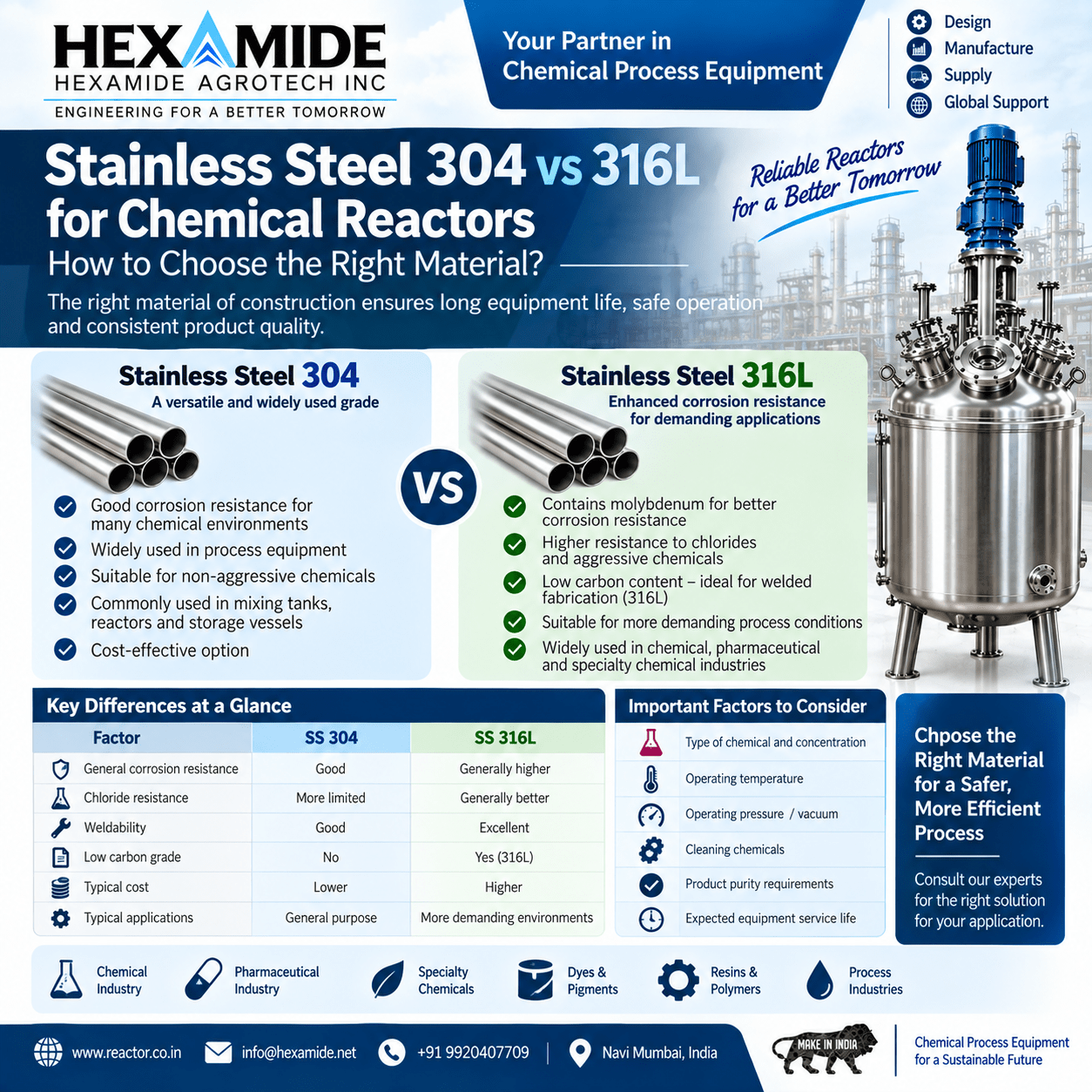
Selecting the correct material of construction is one of the most important decisions when designing a chemical reactor. The material must withstand the chemicals being processed while also meeting the required temperature, pressure, mixing, cleaning, and operating conditions.
Stainless Steel 304 and Stainless Steel 316L are commonly considered for industrial process equipment, but they do not provide identical chemical resistance or performance.
Choosing between 304 and 316L should therefore be based on the actual process conditions rather than simply selecting the more commonly used grade.
1. Why Material Selection Matters in a Chemical Reactor
The reactor material comes into direct or indirect contact with the process environment. An unsuitable material can lead to corrosion, contamination, premature equipment failure, leakage, and increased maintenance requirements.
Material selection should consider:
- Chemical composition
- Chemical concentration
- Operating temperature
- Operating pressure
- Chloride exposure
- Acidity or alkalinity
- Cleaning chemicals
- Product purity requirements
- Expected equipment service life
A proper material assessment should be carried out before finalizing the reactor design.
2. What Is Stainless Steel 304?
Stainless Steel 304 is an austenitic stainless steel widely used in industrial equipment and general process applications.
It offers good corrosion resistance for many environments and is commonly used for equipment such as:
- Mixing tanks
- Storage tanks
- Process vessels
- Chemical equipment
- Food-processing equipment
- General industrial vessels
However, its suitability depends on the specific chemicals and operating conditions involved.
3. What Is Stainless Steel 316L?
Stainless Steel 316L is another austenitic stainless steel that contains molybdenum in addition to chromium and nickel.
The addition of molybdenum generally provides improved resistance to localized corrosion in many chloride-containing environments compared with 304.
The “L” designation indicates low carbon content, which can be beneficial for welded fabrication by reducing the risk of certain forms of corrosion associated with welding.
316L is therefore frequently considered for more demanding process applications.
4. Stainless Steel 304 vs 316L
| Factor | SS 304 | SS 316L |
|---|---|---|
| General corrosion resistance | Good | Generally higher |
| Chloride resistance | More limited | Generally better |
| Weldability | Good | Excellent |
| Low-carbon grade | No | Yes |
| Typical cost | Lower | Higher |
| General process applications | Widely used | Widely used |
| Demanding chemical environments | May be suitable depending on chemistry | Often considered where additional resistance is needed |
The table provides general guidance only. Actual material suitability must be confirmed against the specific process chemistry.
5. When Should You Consider SS 304?
SS 304 may be suitable when the process environment is relatively mild and does not impose demanding corrosion requirements.
Typical considerations include:
- Non-aggressive chemicals
- General mixing applications
- Certain aqueous processes
- Food and related processing
- Storage and handling of compatible materials
However, compatibility should always be checked rather than assuming that SS 304 is suitable simply because it is stainless steel.
6. When Should You Consider SS 316L?
SS 316L may be considered when the process presents more demanding corrosion conditions, particularly where chloride exposure or other aggressive environments are involved.
It is also widely used where cleanliness, weldability, and corrosion resistance are important considerations.
However, 316L is not universally resistant to all chemicals. Some chemical environments can attack even 316L, especially at elevated temperatures or concentrations.
7. Temperature Can Change Material Performance
Chemical compatibility is not determined by chemical name alone.
Temperature can significantly affect corrosion behavior.
For example, a material that performs adequately at one temperature may behave differently at a substantially higher temperature.
Therefore, material selection should consider:
Chemical + concentration + temperature + exposure time + operating conditions
rather than evaluating the chemical in isolation.
8. Consider the Reactor Welding and Fabrication
The reactor is normally fabricated from multiple components that are welded together.
These can include:
- Reactor shell
- Bottom dish
- Top cover
- Jacket or limpet coil
- Nozzles
- Supports
- Agitator components
The welding procedure, joint quality, surface finish, fabrication method, and post-weld treatment can all influence the final equipment performance.
For applications where 316L is selected, low-carbon construction can be particularly useful for welded equipment.
9. Don’t Select Material Based Only on Price
Selecting the cheapest material may reduce the initial equipment cost but can increase long-term costs if corrosion or contamination occurs.
A better approach is to consider the total cost of ownership, including:
- Equipment life
- Maintenance
- Downtime
- Cleaning
- Replacement cost
- Product contamination risk
- Process reliability
The most economical material is not always the material with the lowest purchase price.
10. Consult the Reactor Manufacturer
Material selection should be discussed with the reactor manufacturer during the design stage.
Provide information such as:
- Chemical names
- Concentrations
- Operating temperature
- Operating pressure
- Vacuum conditions
- Batch duration
- Cleaning chemicals
- Required surface finish
- Product purity requirements
This allows the equipment design and material selection to be evaluated together.
Conclusion
Both SS 304 and SS 316L can be valuable materials for chemical reactors, but the correct choice depends on the actual process environment.
SS 304 can be appropriate for many general-purpose applications, while SS 316L may be preferred for applications requiring greater corrosion resistance, including certain chloride-containing environments.
However, neither material should be selected solely from a standard comparison chart. Actual chemical compatibility, concentration, temperature, pressure, and process conditions must be evaluated before finalizing the material of construction.
Hexamide Agrotech Inc manufactures customized stainless steel chemical reactors, jacketed reactors, limpet coil reactors, reaction vessels, and industrial mixing equipment based on specific process requirements.