Introduction
Mixing is one of the most important operations inside a chemical reactor. A properly selected agitator and impeller help maintain uniform temperature, improve mass transfer, disperse solids, and ensure consistent reaction conditions throughout the vessel.
However, there is no single agitator or impeller suitable for every process. The correct selection depends on factors such as liquid viscosity, density, solids concentration, mixing intensity, reactor geometry, operating speed, and the type of process being carried out.
In this guide, we explain the key factors to consider when selecting an agitator and impeller for a chemical reactor.
1. Understand the Mixing Requirement
The first step is to determine what the agitator needs to accomplish.
Depending on the process, mixing may be required for:
- Blending two or more liquids
- Maintaining uniform temperature
- Suspending solid particles
- Dispersing gas into liquid
- Improving heat transfer
- Promoting chemical reactions
- Preventing settling
- Maintaining product consistency
The mixing objective should be clearly defined before selecting the agitator.
2. Consider the Liquid Viscosity
Viscosity has a major influence on agitator selection.
Low-viscosity liquids generally require less mixing power and can often be mixed effectively using axial-flow or radial-flow impellers.
High-viscosity materials require greater torque and may need specialized agitators such as anchor or helical ribbon designs.
Examples of higher-viscosity applications can include:
- Resins
- Polymers
- Adhesives
- Paints
- Thick chemical formulations
- High-viscosity blends
Selecting an agitator without considering viscosity can result in poor circulation, excessive power consumption, or inadequate mixing.
3. Select the Appropriate Impeller
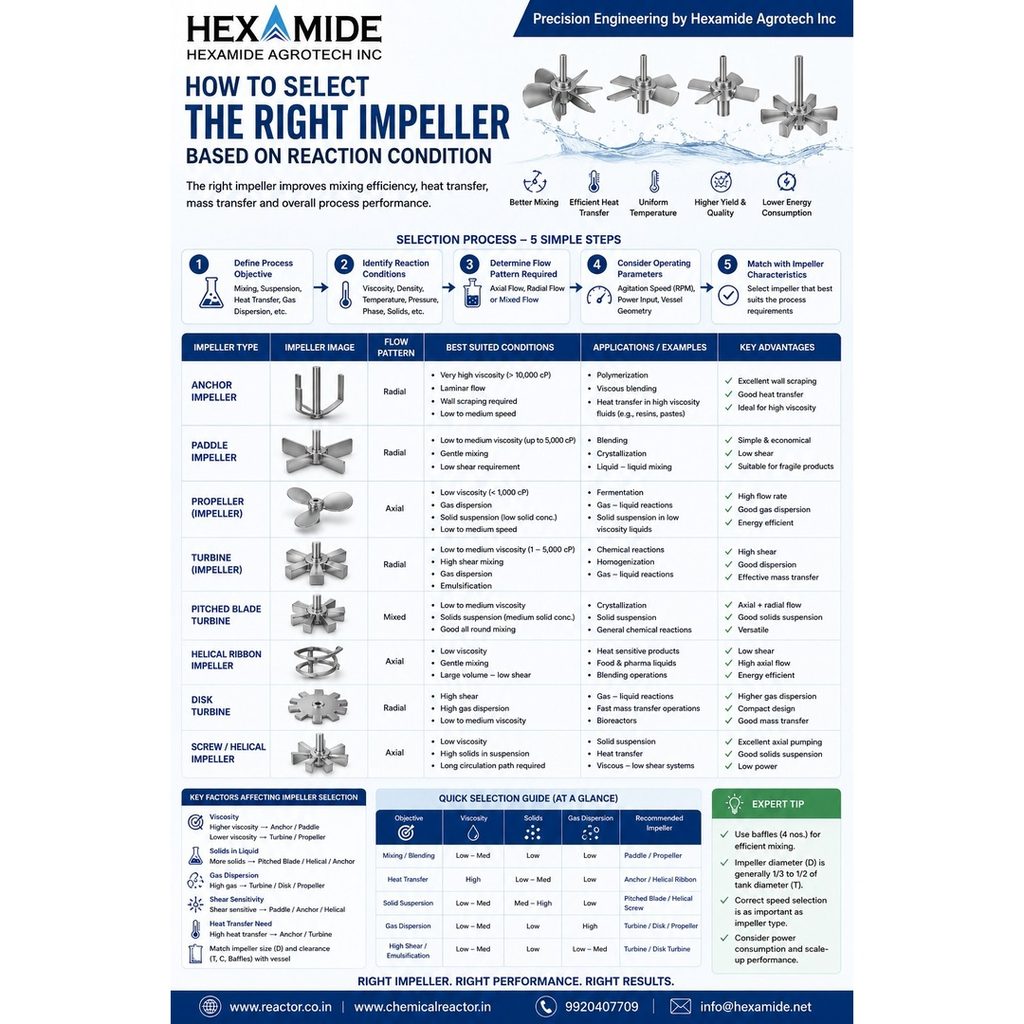
Different impeller designs produce different flow patterns inside the reactor.
Propeller Impeller
Propeller-type impellers are generally suitable for relatively low-viscosity liquids where strong axial circulation is required.
Paddle Impeller
Paddle impellers can be used for relatively simple blending and moderate-viscosity applications.
Turbine Impeller
Turbine impellers can provide strong mixing and are used in applications requiring greater turbulence and radial circulation.
Anchor Agitator
Anchor agitators are commonly considered for viscous products. Their geometry allows them to sweep close to the vessel wall and can help improve bulk circulation and heat transfer.
Helical Ribbon Agitator
Helical ribbon agitators are suitable for many high-viscosity applications where conventional impellers may not provide sufficient circulation.
4. Consider the Reactor Size and Geometry
The agitator should be designed according to the reactor’s internal dimensions.
Important parameters include:
- Reactor diameter
- Straight-side height
- Liquid level
- Bottom geometry
- Baffles
- Impeller diameter
- Impeller position
- Number of impellers
A properly designed agitator should create adequate circulation throughout the working volume rather than simply producing high-speed movement near the impeller.
5. Consider Solids in the Process
If the process contains suspended solids, the agitator must provide sufficient circulation to prevent unwanted settling.
The selection depends on:
- Particle size
- Particle density
- Solids concentration
- Liquid viscosity
- Required suspension level
For certain applications, the impeller design and operating speed may need to be optimized specifically for solids suspension.
6. Heating and Cooling Requirements
Agitation also affects heat transfer.
In a jacketed or limpet coil reactor, proper circulation of the process material helps transfer heat between the vessel wall and the bulk liquid.
This becomes particularly important when the process involves:
- Heating
- Cooling
- Exothermic reactions
- Temperature-sensitive materials
- High-viscosity products
A suitable agitator can help minimize temperature gradients within the reactor.
7. Determine the Required Agitator Speed
Agitator speed should not be selected simply on the basis of RPM.
The required speed depends on the impeller type, reactor size, viscosity, density, and mixing objective.
Higher speed does not necessarily mean better mixing. Excessive speed can increase power consumption, cause unwanted shear, create vortexing, or introduce excessive air into certain processes.
The objective is to achieve the required mixing performance at an appropriate operating speed.
8. Consider Power and Torque Requirements
The agitator drive must provide sufficient power and torque for the application.
Low-viscosity applications may require comparatively lower torque, while high-viscosity materials can require substantially higher torque at relatively low speeds.
The motor, gearbox, shaft, impeller and mechanical seal should therefore be selected as a complete system.
9. Mechanical Seal and Shaft Design
The agitator shaft passes through the reactor and therefore requires an appropriate sealing arrangement.
Depending on the process, the reactor may use:
- Mechanical seals
- Packing arrangements
- Single mechanical seals
- Double mechanical seals
The seal selection should consider temperature, pressure, vacuum, chemical compatibility, shaft speed and process requirements.
Shaft diameter and mechanical strength must also be considered, particularly for large reactors and high-torque applications.
10. Work With an Experienced Reactor Manufacturer
Agitator selection should ideally be carried out together with the reactor design.
An experienced manufacturer can evaluate the process parameters and determine the appropriate combination of:
- Reactor geometry
- Impeller type
- Impeller diameter
- Shaft design
- Motor and gearbox
- Agitator speed
- Baffle arrangement
- Mechanical seal
- Heating and cooling system
This integrated approach can help achieve reliable and consistent mixing performance.
Conclusion
Choosing the right agitator and impeller is essential for achieving effective mixing inside a chemical reactor. The selection should be based on the process objective, viscosity, density, solids content, reactor geometry, heat-transfer requirements, operating speed, and required power and torque.
A properly designed agitation system can contribute to better temperature uniformity, improved product consistency, efficient heat transfer, and reliable process operation.
Hexamide Agrotech Inc designs and manufactures chemical reactors, stainless steel reactors, jacketed reactors, limpet coil reactors, mixing tanks, and customized agitation systems for industrial applications.