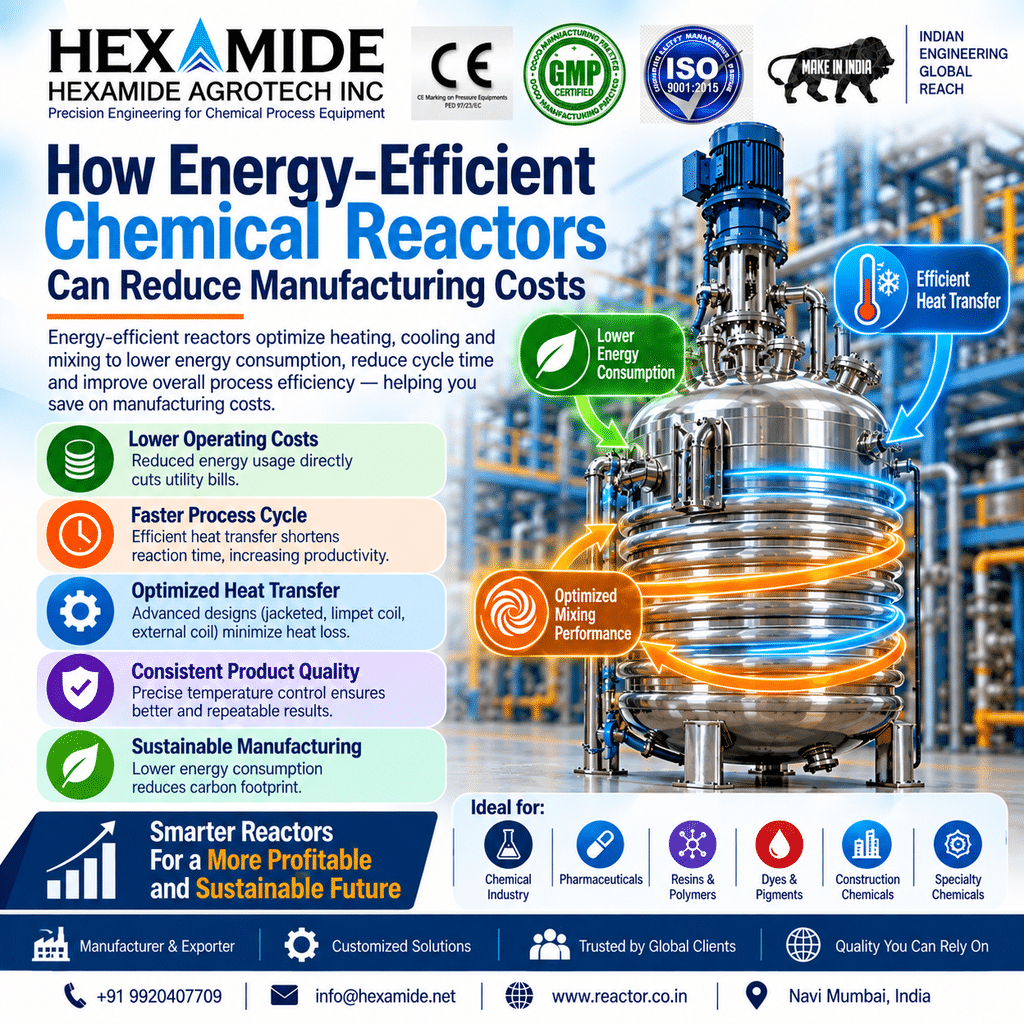
Energy is one of the major operating costs in many chemical manufacturing processes. Heating raw materials, maintaining reaction temperature, cooling batches, operating agitators, and running pumps can consume significant amounts of energy.
As energy prices and sustainability requirements become increasingly important, manufacturers are looking at ways to improve reactor energy efficiency without compromising production quality.
A properly designed chemical reactor can reduce unnecessary heat loss, improve heat transfer, shorten processing time, and make better use of heating and cooling utilities.
This article explains the major factors affecting chemical reactor energy efficiency and practical ways manufacturers can reduce energy consumption.
What Is an Energy-Efficient Chemical Reactor?
An energy-efficient chemical reactor is a reactor system designed to achieve the required reaction conditions while minimizing unnecessary energy consumption.
Energy efficiency depends on more than the reactor vessel itself. The overall system includes:
- Reactor design
- Heating and cooling system
- Heat-transfer surface
- Agitator and impeller
- Insulation
- Process temperature
- Batch size
- Reaction time
- Utility system
- Automation and process control
For example, a reactor with excellent insulation but inadequate heat-transfer area may still consume excessive energy because the batch takes too long to reach the required temperature.
Therefore, reactor design and process requirements must be considered together.
1. Improve Heat Transfer
Heat transfer is one of the most important factors affecting reactor energy consumption.
A chemical reactor may use:
- Jacket
- Limpet coil
- Half-pipe coil
- Internal coil
- External heat exchanger
The appropriate configuration depends on the process.
Better heat transfer can help the reactor reach the desired temperature faster and reduce the duration for which heating utilities need to operate.
Factors affecting heat transfer include:
- Heat-transfer surface area
- Product viscosity
- Agitation
- Temperature difference
- Heating/cooling medium
- Reactor geometry
- Fouling
- Material thickness
2. Select the Right Heating and Cooling System
Different chemical processes require different heating and cooling arrangements.
Common heating media include:
- Steam
- Hot water
- Thermal oil
- Electrical heating
Cooling may use:
- Cooling water
- Chilled water
- Brine
- Refrigeration systems
Selecting a heating or cooling medium based on the required operating temperature can significantly affect overall energy consumption.
The objective should be to provide the required heat-transfer duty efficiently rather than simply selecting the highest-capacity utility system.
3. Optimize Agitator Selection
Agitation consumes electrical energy continuously during many batch processes.
An oversized agitator or unnecessarily high operating speed can increase power consumption.
However, reducing agitator speed without considering the process can negatively affect:
- Mixing
- Heat transfer
- Suspension
- Reaction uniformity
- Mass transfer
The correct approach is to select the impeller type, diameter, speed, and motor power according to the actual process requirements.
For example, high-viscosity products may require a completely different mixing arrangement from low-viscosity liquids.
4. Use VFD Control for Agitators
A Variable Frequency Drive (VFD) allows agitator speed to be adjusted according to process requirements.
Instead of operating the agitator continuously at maximum speed, the process can use different speeds during different stages.
For example:
Charging → Low speed
Initial mixing → Medium speed
Reaction → Process-specific speed
Final blending → Optimized speed
This can reduce unnecessary motor energy consumption while providing better process control.
5. Improve Reactor Insulation
Heat lost through the reactor surface represents wasted energy.
Proper insulation around the reactor, jacket, piping, valves, and associated equipment can reduce heat loss.
Common insulation materials include systems based on:
- Mineral wool
- Rock wool
- Ceramic materials
- Other industrial insulation systems
The appropriate insulation thickness depends on operating temperature, environmental conditions, equipment geometry, and applicable engineering requirements.
For high-temperature processes, insulation can be particularly important.
6. Reduce Unnecessary Heating and Cooling Cycles
Some manufacturing processes repeatedly heat and cool the same batch.
This can result in substantial energy consumption.
Process engineers should evaluate whether the process sequence can be improved.
For example:
Heating → Reaction → Cooling
may sometimes be optimized through better process sequencing, heat recovery, or improved temperature control.
Where technically suitable, recovering heat from one process stream and using it elsewhere can further improve energy utilization.
7. Maintain Clean Heat-Transfer Surfaces
Fouling can reduce heat-transfer efficiency.
Deposits on the reactor side, jacket side, or associated heat-transfer equipment can increase thermal resistance.
The result may be:
Lower heat transfer → Longer heating/cooling time → Higher energy consumption
Regular inspection and appropriate cleaning procedures can therefore contribute to maintaining reactor efficiency.
8. Optimize Reactor Batch Size
Operating a reactor significantly below its intended working capacity can sometimes increase energy consumption per kilogram of product.
For example, if the same reactor is repeatedly used for very small batches, the energy required to heat the reactor vessel and surrounding equipment may represent a larger proportion of the total energy used.
However, batch size should never be increased beyond safe or technically suitable operating limits.
Manufacturers should consider:
- Minimum working volume
- Maximum working volume
- Mixing requirements
- Heat-transfer requirements
- Freeboard
- Reaction expansion
- Pressure and vacuum requirements
9. Use Accurate Temperature Control
Poor temperature control can cause unnecessary heating and cooling.
Modern control systems can continuously monitor reactor temperature and regulate heating or cooling based on the required set point.
A properly tuned PID control system can help reduce temperature fluctuations and improve process consistency.
For more advanced installations, process data can also be recorded and analyzed to identify opportunities for optimization.
10. Monitor Energy Consumption
You cannot effectively improve energy efficiency without measuring it.
Manufacturers can monitor parameters such as:
- Heating time
- Cooling time
- Steam consumption
- Thermal-oil consumption
- Electrical consumption
- Agitator power
- Batch duration
- Production quantity
A useful performance indicator is:
Energy consumed per kg of product
Comparing this value between batches can help identify process variations and improvement opportunities.
Smart Reactors and Energy Efficiency
Digitalization is creating new opportunities for energy optimization.
A smart chemical reactor can combine sensors, PLC/SCADA systems, data logging, and process analytics.
For example, historical data can help engineers identify:
- Increasing heating time
- Declining heat-transfer performance
- Abnormal agitator load
- Excessive cooling duration
- Process temperature variations
- Changes in batch cycle time
This information can support preventive maintenance and process optimization.
However, automation should complement sound reactor and process engineering rather than replace it.
Role of Heat Transfer in Energy-Efficient Reactor Design
Heat-transfer performance is particularly important for:
- Exothermic reactions
- Endothermic reactions
- Polymerization
- Resin manufacturing
- High-viscosity processing
- Temperature-sensitive reactions
- Solvent evaporation
- Controlled crystallization
A reactor with appropriately designed heat-transfer surfaces can respond more effectively to heating and cooling requirements.
The required heat-transfer area should be determined from the actual process duty rather than using a generic surface-area assumption.
Jacketed Reactor vs Limpet Coil for Energy Efficiency
Both jacketed and limpet-coil reactors can be suitable for heating and cooling.
The appropriate choice depends on:
- Required heat-transfer area
- Operating pressure
- Product viscosity
- Reactor size
- Heating/cooling medium
- Temperature range
- Fabrication requirements
- Process duty
There is no universal answer that one configuration is always more energy efficient.
The reactor should be designed around the actual heating and cooling requirement of the process.
Can Energy-Efficient Reactors Reduce Production Costs?
Yes, improving reactor energy efficiency can potentially reduce operating costs.
Savings may come from:
- Lower electricity consumption
- Reduced steam consumption
- Reduced thermal-oil consumption
- Lower cooling requirements
- Shorter batch cycles
- Reduced production downtime
- Better equipment utilization
However, the actual financial benefit depends on the process, production volume, utility costs, reactor design, and operating conditions.
7 Practical Steps to Improve Reactor Energy Efficiency
Manufacturers can begin with a simple review:
Step 1
Measure current heating and cooling time.
Step 2
Check reactor insulation condition.
Step 3
Inspect heat-transfer surfaces for fouling.
Step 4
Review agitator RPM and motor loading.
Step 5
Check whether heating and cooling utilities are properly selected.
Step 6
Review temperature-control performance.
Step 7
Compare energy consumption between batches.
These measurements can provide a useful starting point for identifying energy-saving opportunities.
The Future of Energy-Efficient Chemical Reactors
The future of chemical reactor design is moving toward the integration of:
Efficient Heat Transfer + Optimized Mixing + Automation + Data Monitoring + Process Engineering
Advanced process-control systems can help manufacturers understand their reactor performance in greater detail.
Combined with appropriate equipment design, these technologies can support manufacturers seeking to improve energy efficiency, productivity, process consistency, and operating costs.
Conclusion
Energy efficiency in chemical manufacturing starts with good process and equipment design.
An energy-efficient chemical reactor is not simply a reactor with a large heating surface or a high-powered agitator. The complete system must be optimized for the actual reaction.
Important factors include heat-transfer area, agitator design, insulation, temperature control, utility selection, batch size, fouling, and process duration.
For manufacturers planning a new reactor or upgrading an existing system, evaluating these factors can help identify opportunities to reduce energy consumption while maintaining reliable production.
About Hexamide Agrotech Inc.
Hexamide Agrotech Inc. manufactures and supplies chemical process equipment including:
- Chemical Reactors
- Jacketed Reactors
- Limpet Coil Reactors
- Stainless Steel Reactors
- Reaction Vessels
- Mixing Tanks
- Blending Tanks
- Resin Kettles
- Process Equipment
We provide equipment solutions designed around the specific process requirements of chemical and allied industries.
Website: www.reactor.co.in
Email: info@hexamide.net
Phone: +91 9920407709
Location: Navi Mumbai, Maharashtra, India