
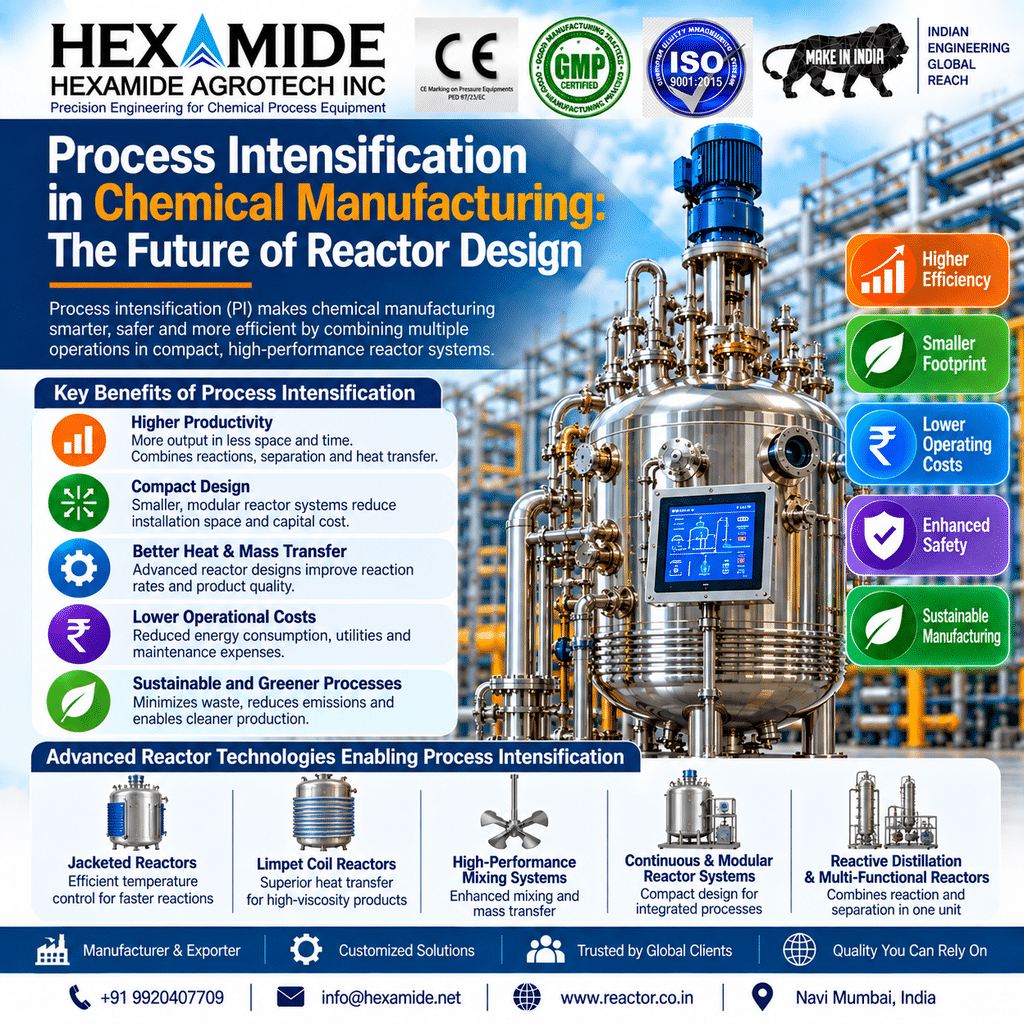
Chemical manufacturers are under increasing pressure to produce more while using less energy, raw materials, space, and time. This has increased interest in process intensification, an approach that aims to make chemical processes more efficient by improving the way heat, mass, mixing, and reactions occur.
For reactor manufacturers, process intensification is becoming an important area of modern process equipment design.
In this blog, we explain what process intensification means, how it affects chemical reactors, its benefits, applications, and how manufacturers can evaluate whether an intensified reactor design is suitable for their process.
What Is Process Intensification?
Process intensification (PI) is the development of chemical processes and equipment that achieve the required production performance using more efficient process configurations.
Instead of simply making equipment larger to increase production, process intensification looks at ways to improve:
- Heat transfer
- Mass transfer
- Mixing
- Reaction rates
- Energy utilization
- Equipment volume
- Production time
The goal is to achieve greater process performance while maintaining safe and reliable operation.
Why Is Process Intensification Important?
Traditional chemical manufacturing often relies on large equipment, long residence times, and significant utility consumption.
Modern manufacturers are increasingly looking for ways to:
- Reduce energy consumption
- Increase production capacity
- Reduce batch time
- Improve heat transfer
- Improve mixing
- Reduce equipment footprint
- Improve process control
- Reduce waste
- Increase process consistency
Process intensification can address some of these objectives through improved reactor and process design.
How Does Process Intensification Work?
Process intensification can involve improvements in several areas.
1. Improved Heat Transfer
Efficient heat transfer can help a reactor heat or cool the process material more quickly.
This can be achieved through appropriate:
- Jacket design
- Limpet coil design
- Internal heat-transfer surfaces
- Heat exchangers
- Agitation systems
- Process temperature control
Better heat transfer can potentially reduce heating and cooling time.
2. Improved Mixing
Mixing has a direct influence on many chemical reactions.
An appropriate agitator and impeller can improve:
- Temperature uniformity
- Concentration uniformity
- Solid suspension
- Gas dispersion
- Reaction uniformity
- Heat transfer
However, the objective is not simply to increase agitator speed.
The agitator should be selected according to viscosity, density, phase composition, shear requirement, batch volume, and process conditions.
3. Higher Heat and Mass Transfer Rates
Some intensified reactor designs aim to increase the contact between different phases or improve transport of heat and mass.
This can be particularly relevant to:
- Gas-liquid reactions
- Liquid-liquid reactions
- Gas-liquid-solid systems
- Highly viscous processes
- Fast reactions
- Exothermic reactions
Improved transport can potentially reduce the time required to achieve the desired process result.
Batch Reactors and Process Intensification
Batch reactors remain widely used in specialty chemicals, pharmaceuticals, resins, agrochemicals, and other industries.
Process intensification does not necessarily mean replacing every batch reactor with continuous equipment.
A batch reactor can itself be improved through:
- Better agitator design
- Improved heat-transfer surfaces
- Automated dosing
- Better temperature control
- Optimized reaction sequence
- Improved instrumentation
- Process monitoring
For many manufacturers, improving an existing batch process may be more practical than completely changing the production technology.
Continuous Reactors and Process Intensification
Continuous processing is another important area associated with process intensification.
In a continuous reactor, raw materials continuously enter the system while product continuously exits.
Potential advantages can include:
- Smaller equipment volume for certain processes
- Continuous production
- Better control of residence time
- Potentially improved heat transfer
- Consistent operating conditions
However, continuous processing is not suitable for every chemical reaction.
The decision depends on factors such as:
- Reaction kinetics
- Residence time
- Feed characteristics
- Product requirements
- Fouling tendency
- Solids formation
- Process safety
- Production volume
Process Intensification Through Better Agitation
Agitation can be one of the most practical areas for reactor improvement.
Different processes may require different impellers, including:
- Anchor agitators
- Paddle agitators
- Propellers
- Turbine impellers
- High-shear mixers
- Cowles-type dispersers
- Specialized impellers
For high-viscosity materials, an anchor or other suitable close-clearance arrangement may provide better bulk movement than a conventional high-speed turbine.
For low-viscosity liquids, a different impeller may provide the required circulation with lower power consumption.
The correct impeller depends on the process—not simply the reactor volume.
Process Intensification and High-Viscosity Products
High-viscosity products present special challenges.
As viscosity increases:
- Mixing becomes more difficult
- Heat transfer may become slower
- Motor load can increase
- Dead zones can develop
- Processing time can increase
For such applications, reactor design may involve:
- Close-clearance agitators
- Anchor agitators
- Scraper arrangements
- Multiple agitators
- Specialized impellers
- Optimized jacket or coil design
The objective is to improve material circulation and heat transfer throughout the reactor.
Process Intensification and Energy Efficiency
Energy consumption is an important consideration in reactor design.
If a process requires long heating and cooling cycles, energy consumption can increase significantly.
Process intensification can potentially improve energy performance by:
- Increasing heat-transfer efficiency
- Reducing processing time
- Optimizing agitation
- Improving temperature control
- Recovering process heat
- Reducing unnecessary heating and cooling
However, energy performance should be evaluated using actual process data rather than assumptions.
Can Process Intensification Reduce Reactor Size?
In some processes, improved heat and mass transfer can allow the required process duty to be achieved with a smaller equipment volume.
However, smaller does not automatically mean better.
A reactor must still provide adequate:
- Working volume
- Mixing
- Residence time
- Heat-transfer area
- Freeboard
- Pressure capacity
- Safety margin
- Cleaning access
The appropriate reactor size should be calculated from the actual process requirements.
Role of Automation in Process Intensification
Automation can complement intensified equipment design.
A modern reactor may incorporate:
- Temperature transmitters
- Pressure transmitters
- Flowmeters
- Level sensors
- Load cells
- VFD-driven agitators
- Automated valves
- PLC controls
- HMI
- SCADA
- Data logging
This allows operators and engineers to monitor the process and identify deviations more quickly.
When historical process data is available, engineers can also analyze batch performance and identify opportunities for further optimization.
Process Intensification and Smart Chemical Reactors
The combination of process intensification and smart reactor technology represents an important direction for modern chemical manufacturing.
For example:
Intensified Reactor Design
↓
Better Heat & Mass Transfer
↓
Sensors & Automation
↓
Real-Time Process Data
↓
Process Optimization
This approach can provide manufacturers with greater visibility into how equipment is performing.
Applications of Process Intensification
Process intensification concepts can be relevant to several industries.
Specialty Chemicals
For improving reaction rates, mixing, and production capacity.
Pharmaceutical Manufacturing
For processes requiring precise temperature, mixing, and residence-time control.
Resin Manufacturing
For managing heat transfer and mixing in increasingly viscous materials.
Agrochemicals
For controlled reactions and improved production efficiency.
Paints and Coatings
For dispersion and high-shear mixing applications.
Oil and Lubricants
For blending and controlled processing.
Petrochemicals
For selected reaction and separation processes where intensified designs are technically suitable.
What Should You Consider Before Intensifying a Reactor?
Before modifying an existing reactor or designing a new intensified reactor, evaluate:
Process Chemistry
Understand reaction kinetics, heat release, corrosion, and operating conditions.
Viscosity
Viscosity can significantly influence mixing and heat transfer.
Heat Duty
Calculate the actual heating and cooling requirement.
Mixing Requirement
Determine the appropriate impeller, speed, and power requirement.
Material of Construction
Select the MOC based on the actual chemical environment.
Safety
Evaluate pressure, temperature, runaway reaction potential, relief systems, and other applicable safeguards.
Production Requirement
Determine whether the process should remain batch, become semi-continuous, or potentially move toward continuous operation.
Process Intensification vs Conventional Reactor Design
| Parameter | Conventional Approach | Intensified Approach |
|---|---|---|
| Heat transfer | Conventional surface area | Optimized heat-transfer design |
| Mixing | Standard agitator | Process-specific optimized mixing |
| Equipment size | May be larger | Can potentially be reduced for suitable processes |
| Processing time | Process-dependent | May be reduced in suitable applications |
| Energy use | Process-dependent | Potential optimization |
| Automation | Basic to advanced | Often integrated with process optimization |
| Data monitoring | Variable | Increasingly important |
| Design approach | Equipment-focused | Process + equipment focused |
The table describes general design tendencies; actual performance depends on the process.
Is Process Intensification Suitable for Every Chemical Plant?
No.
Process intensification is highly process-specific.
It may be attractive where manufacturers have:
- Long processing times
- High energy consumption
- Heat-transfer limitations
- Mixing limitations
- Large equipment footprints
- High production requirements
But changing equipment without understanding the chemistry and process constraints can create new problems.
A proper engineering evaluation should be performed before implementing an intensified design.
The Future of Process Intensification
Chemical engineering is increasingly moving toward more efficient, compact, connected, and data-driven process equipment.
Future reactor development is likely to combine:
Advanced Mixing + Improved Heat Transfer + Process Intensification + Automation + Digital Monitoring
For chemical equipment manufacturers, this means reactor design is increasingly becoming more than simply selecting a vessel size.
It involves understanding the complete process and designing equipment around the required heat transfer, mass transfer, mixing, reaction, control, and safety requirements.
Conclusion
Process intensification is an important approach to improving chemical manufacturing efficiency.
By optimizing heat transfer, mixing, mass transfer, reaction conditions, automation, and equipment configuration, manufacturers may be able to improve productivity while reducing processing time, energy consumption, or equipment footprint in suitable applications.
The key is to avoid treating process intensification as a single piece of equipment or technology. It is a process-design philosophy that combines chemical engineering with optimized equipment design.
For manufacturers considering a new chemical reactor, upgrading an existing reactor, or improving production efficiency, process intensification can be evaluated alongside conventional reactor design to determine the most suitable solution.
About Hexamide Agrotech Inc.
Hexamide Agrotech Inc. manufactures chemical process equipment including:
- Chemical Reactors
- Jacketed Reactors
- Limpet Coil Reactors
- Stainless Steel Reactors
- Reaction Vessels
- Mixing Tanks
- Blending Tanks
- Resin Kettles
- Industrial Process Equipment
Our equipment is designed around application-specific requirements for chemical and allied industries.
Website: www.reactor.co.in
Email: info@hexamide.net
Phone: +91 9920407709
Location: Navi Mumbai, Maharashtra, India