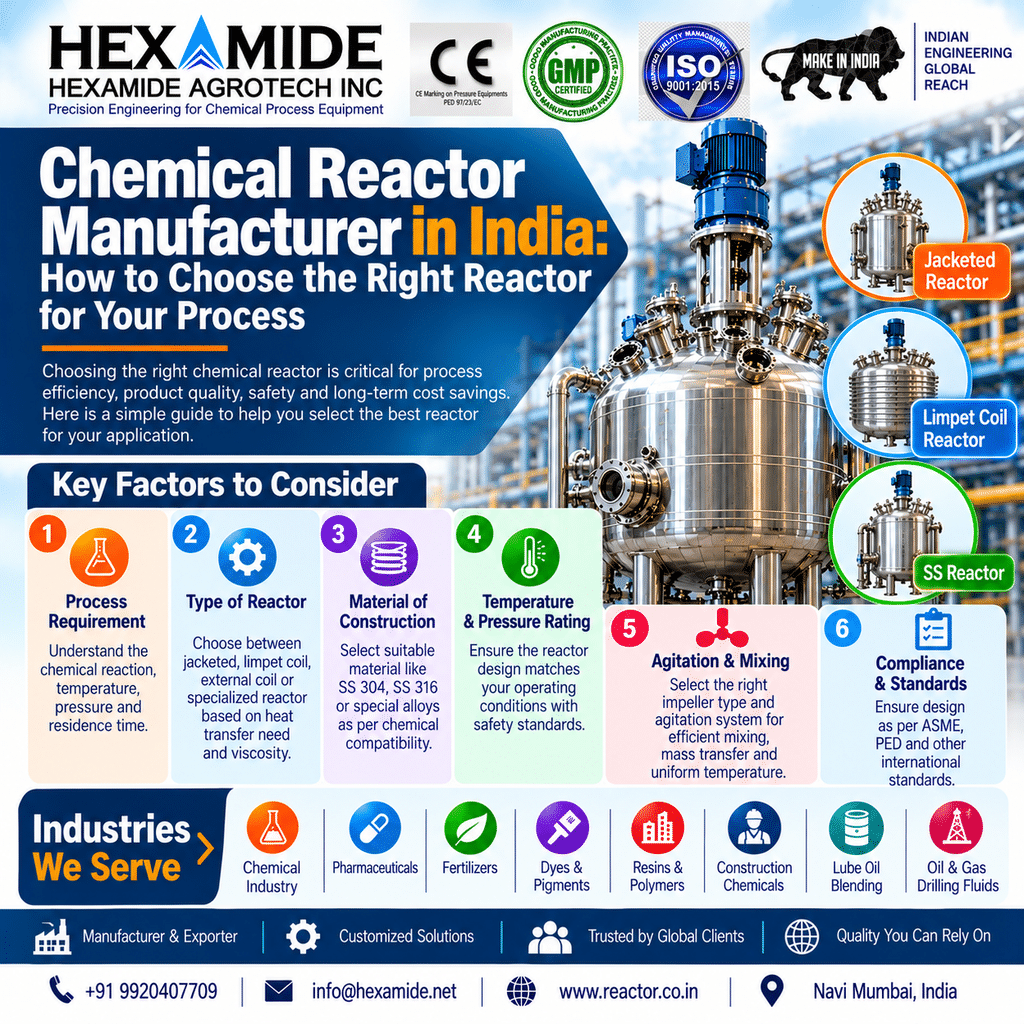
Choosing the right chemical reactor is an important decision for any chemical manufacturing plant. Reactor design directly affects reaction efficiency, heating and cooling performance, mixing, product quality, safety, production capacity, and operating cost.
With many types of reactors available—including stainless steel reactors, jacketed reactors, limpet coil reactors, and reaction vessels—selecting the correct equipment requires more than simply choosing a reactor based on capacity.
This guide explains the key factors to consider when selecting a chemical reactor for industrial applications.
What Is a Chemical Reactor?
A chemical reactor is process equipment designed to provide controlled conditions for a chemical reaction.
Depending on the application, a reactor may control:
- Temperature
- Pressure
- Mixing
- Reaction time
- Heat transfer
- Material addition
- Vacuum
- Residence time
Industrial chemical reactors are used across chemical, pharmaceutical, agrochemical, resin, specialty chemical, paint, lubricant, and other process industries.
Types of Chemical Reactors
Different manufacturing processes require different reactor configurations.
1. Stainless Steel Chemical Reactor
Stainless steel reactors are widely used for chemical processing where corrosion resistance, durability, cleanability, and mechanical strength are important.
Common stainless steel grades include:
- SS 304
- SS 316
- SS 316L
The appropriate material should always be selected according to the actual chemical composition, concentration, temperature, pressure, and operating environment.
2. Jacketed Chemical Reactor
A jacketed chemical reactor has an external jacket surrounding the reactor vessel.
Heating or cooling media can circulate through the jacket to control the process temperature.
Typical heating and cooling media include:
- Steam
- Hot water
- Thermal oil
- Cooling water
- Chilled water
- Brine
Jacketed reactors are commonly used where controlled heating and cooling are required.
3. Limpet Coil Reactor
A limpet coil reactor uses a fabricated coil around the reactor shell for heating or cooling.
Limpet coils can provide a practical heat-transfer arrangement for various industrial processes.
The selection between a jacket and limpet coil depends on factors such as:
- Reactor size
- Required heat-transfer area
- Operating pressure
- Heating/cooling medium
- Process temperature
- Product viscosity
- Fabrication requirements
4. Reaction Vessel
A reaction vessel is designed around the requirements of a particular chemical process.
It may incorporate:
- Agitator
- Baffles
- Heating/cooling system
- Pressure/vacuum connections
- Charging nozzles
- Sampling arrangement
- Instrumentation
- Safety devices
The final configuration should be based on the process rather than simply the vessel volume.
How to Select the Right Chemical Reactor
Several important factors should be evaluated before purchasing or designing a reactor.
1. Understand the Chemical Reaction
The first step is understanding the reaction itself.
Important parameters include:
- Reaction temperature
- Reaction pressure
- Reaction time
- Heat generation
- Heat absorption
- Chemical compatibility
- Viscosity changes
- Gas generation
- Solid formation
A reactor should be designed around these conditions.
2. Select the Correct Material of Construction
Material selection is one of the most important parts of reactor design.
Depending on the process, manufacturers may consider:
- Stainless steel
- Carbon steel
- Hastelloy
- Nickel alloys
- Glass-lined construction
- Other corrosion-resistant materials
For stainless steel reactors, SS 304 and SS 316L are frequently considered for industrial applications, but neither should be selected solely because it is commonly used.
Chemical compatibility should be evaluated for the complete operating conditions.
3. Determine the Required Reactor Capacity
Reactor capacity should be calculated according to the required batch size and operating volume.
For example, a reactor may be described as:
- 1 KL
- 2 KL
- 5 KL
- 8 KL
- 10 KL
- 15 KL
- 20 KL
- 30 KL
- 50 KL
The nominal vessel volume is not necessarily the same as the recommended working volume.
Adequate freeboard may be required for:
- Agitation
- Foaming
- Thermal expansion
- Gas evolution
- Reaction expansion
- Safe operation
4. Consider Heating and Cooling Requirements
Many chemical reactions require accurate temperature control.
The reactor may require:
Heating → Reaction → Cooling
The required heat-transfer system depends on the process duty.
Engineers should consider:
- Required heating rate
- Required cooling rate
- Batch size
- Product viscosity
- Starting temperature
- Final temperature
- Utility temperature
- Heat-transfer area
A reactor with inadequate heat-transfer capability may take too long to heat or cool.
5. Choose the Correct Agitator
Agitation is critical for achieving uniform conditions inside the reactor.
The correct agitator depends on:
- Viscosity
- Density
- Solid concentration
- Gas-liquid interaction
- Required shear
- Mixing time
- Heat-transfer requirements
Possible configurations include:
- Propeller
- Paddle
- Turbine
- Anchor
- High-speed disperser
- Specialized impeller
Increasing RPM is not always the solution to poor mixing.
The impeller geometry and operating conditions are equally important.
6. Consider Product Viscosity
Viscosity can change significantly during a chemical reaction.
This is particularly important for:
- Resins
- Polymers
- Adhesives
- Coatings
- High-viscosity chemicals
- Lubricant formulations
A reactor that works well with a low-viscosity liquid may not provide adequate mixing when the product becomes highly viscous.
The agitator, motor, shaft, mechanical seal, and heat-transfer arrangement should therefore be evaluated for the complete viscosity range.
7. Determine Operating Pressure and Vacuum
Some processes operate under:
- Atmospheric pressure
- Vacuum
- Positive pressure
- Alternating vacuum and pressure
The vessel design must consider the applicable pressure and vacuum requirements.
Connections, flanges, nozzles, seals, instrumentation, and safety systems must be selected accordingly.
Pressure and vacuum design should be handled according to applicable engineering codes and regulatory requirements.
8. Consider Reactor Automation
Modern chemical manufacturing increasingly uses automation for process monitoring and control.
A reactor can be equipped with:
- Temperature sensors
- Pressure transmitters
- Level measurement
- VFD
- Load cells
- Automated valves
- Flowmeters
- PLC
- HMI
- SCADA
Automation can help operators monitor important parameters and maintain repeatable process conditions.
9. Evaluate Cleaning Requirements
Cleaning requirements are particularly important in pharmaceutical, specialty chemical, food-related, and high-purity applications.
Consider:
- Internal surface finish
- Drainability
- Nozzle arrangement
- Manhole access
- Cleaning method
- Product residues
- Dead zones
The reactor should be designed to suit the actual cleaning procedure.
10. Consider Future Production Requirements
A reactor should ideally be selected with the manufacturer’s expected production requirements in mind.
Consider:
- Current batch size
- Future capacity
- Number of batches per day
- Product range
- Production cycle time
- Utility availability
- Plant space
Selecting equipment only for today’s production requirement may create limitations when production increases.
Chemical Reactor Design Is More Than Vessel Capacity
A common mistake is to select a reactor primarily based on capacity.
For example:
“We need a 10 KL reactor.”
This is only the beginning of the engineering discussion.
A proper reactor specification may also need to define:
- Working volume
- MOC
- Design pressure
- Design temperature
- Operating pressure
- Operating temperature
- Heating/cooling system
- Heat-transfer area
- Agitator type
- Motor power
- Shaft design
- Mechanical seal
- Nozzle arrangement
- Instrumentation
- Automation
- Safety requirements
This is why reactor selection should be treated as a process-engineering exercise rather than simply an equipment purchase.
Chemical Reactor Applications
Industrial chemical reactors can be used for:
Chemical Manufacturing
Chemical synthesis and controlled reactions.
Pharmaceutical Manufacturing
Controlled reaction and processing applications.
Resin Manufacturing
Resin and polymer-related processes requiring controlled heating and agitation.
Agrochemical Manufacturing
Chemical synthesis and formulation processes.
Paint and Coating Manufacturing
Reaction, dispersion, and formulation applications.
Lubricant Manufacturing
Blending and temperature-controlled processing.
Specialty Chemicals
Custom processes requiring specific temperature, mixing, and material compatibility.
Why Customized Reactor Design Matters
Every chemical process has different requirements.
Two reactors with identical capacity may require completely different designs because their:
- Chemicals
- Viscosities
- Temperatures
- Pressures
- Heat-transfer requirements
- Mixing requirements
- Production cycles
may be different.
A customized reactor specification can therefore help ensure that the equipment matches the process.
Questions to Ask a Chemical Reactor Manufacturer
Before placing an order, discuss the following with the manufacturer:
- What is the required working volume?
- What chemicals will be processed?
- What is the operating temperature?
- What is the design temperature?
- What is the operating pressure?
- Is vacuum operation required?
- What heating medium will be used?
- What cooling medium will be used?
- What is the product viscosity?
- What type of mixing is required?
- What material of construction is suitable?
- What level of automation is required?
- What cleaning method will be used?
- What safety requirements apply?
Providing accurate process information allows the reactor manufacturer to develop a more appropriate equipment design.
Why Choose a Chemical Reactor Manufacturer With Engineering Expertise?
Manufacturing a reactor involves more than fabricating a cylindrical vessel.
A complete solution requires consideration of:
Process → Mechanical Design → Heat Transfer → Mixing → Materials → Fabrication → Instrumentation → Testing
An experienced manufacturer can coordinate these elements to develop equipment suitable for the intended application.
Chemical Reactor Manufacturer in India
Hexamide Agrotech Inc. manufactures and supplies industrial chemical process equipment for chemical and allied industries.
Our product range includes:
- Chemical Reactors
- Stainless Steel Reactors
- Jacketed Chemical Reactors
- Limpet Coil Reactors
- Reaction Vessels
- Resin Kettles
- Liquid Mixing Tanks
- Blending Tanks
- High-Speed Mixers
- Ribbon Blenders
- Process Equipment
We focus on application-oriented equipment design, fabrication, mixing technology, and process requirements.
Website: www.reactor.co.in
Email: info@hexamide.net
Phone: +91 9920407709
Location: Navi Mumbai, Maharashtra, India