Introduction
Heating and cooling are critical operations in many chemical processes. A chemical reactor may need to reach a specific temperature before a reaction begins, maintain a controlled temperature during the reaction, or cool the batch before discharge.
When a reactor takes longer than expected to heat or cool, it can increase batch cycle time, energy consumption and production costs. It may also affect product quality if the process depends on accurate temperature control.
There can be several reasons for slow heating or cooling performance. The problem may be related to the heat-transfer system, process material, agitation, utilities, reactor loading or operating conditions.
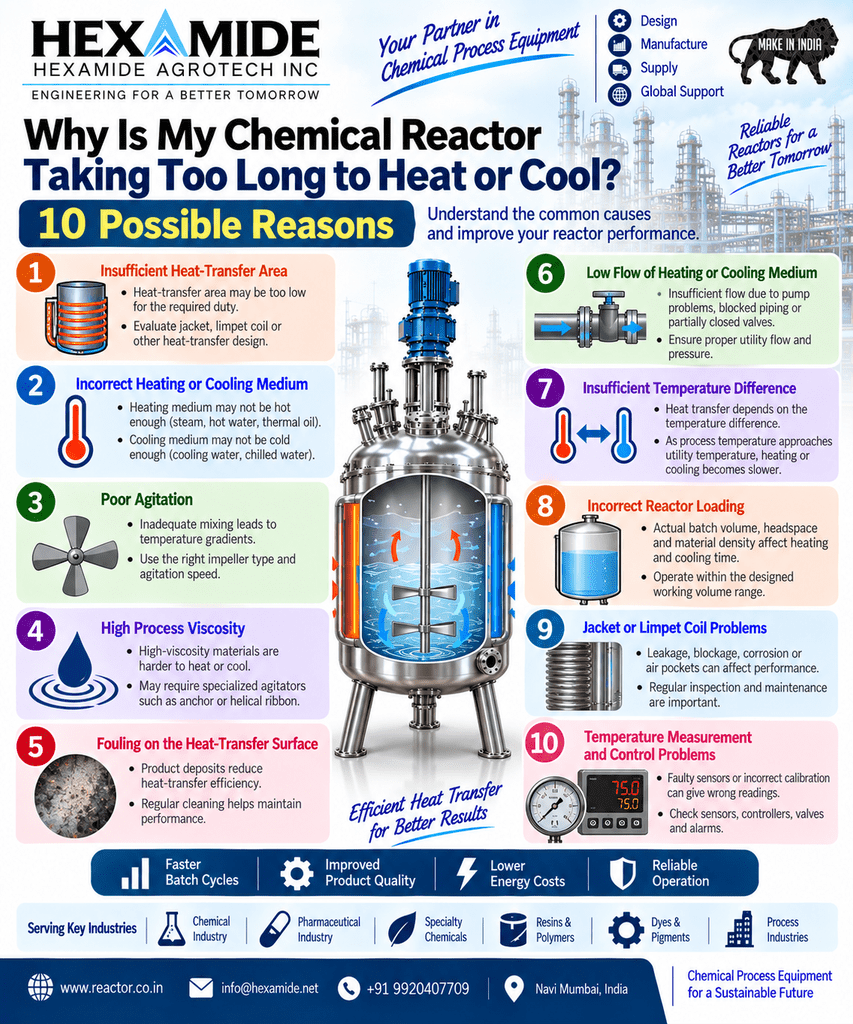
Here are 10 important factors to investigate.
1. Insufficient Heat-Transfer Area
The available heat-transfer area has a direct influence on heating and cooling performance.
A reactor may use a jacket, limpet coil or another heat-transfer arrangement. If the available area is insufficient for the required heat load, the reactor may take longer to reach the target temperature.
Heat-transfer area should be evaluated based on:
- Batch volume
- Process temperature
- Heating or cooling duty
- Required heating or cooling time
- Process material properties
- Heating or cooling medium
Reactor sizing should therefore include a proper heat-transfer calculation rather than considering vessel volume alone.
2. Incorrect Heating or Cooling Medium
The heating or cooling medium must be suitable for the required process temperature.
Common heating media include:
- Steam
- Hot water
- Thermal oil
Common cooling media include:
- Cooling water
- Chilled water
- Refrigerated fluids
If the heating medium is not hot enough or the cooling medium is not sufficiently cold, the required temperature difference may not be available.
3. Poor Agitation
Agitation has a major effect on heat transfer.
The reactor wall or heat-transfer surface may be at a different temperature from the bulk material. Proper agitation circulates the material and helps distribute heat throughout the reactor.
Poor agitation can result in:
- Temperature gradients
- Slow heating
- Slow cooling
- Localized hot or cold areas
- Inconsistent product temperature
The agitator and impeller should be selected according to viscosity, density, solids content and process requirements.
4. High Process Viscosity
High-viscosity materials can be significantly more difficult to heat or cool than low-viscosity liquids.
As viscosity increases, natural circulation and mixing can become more difficult.
Products such as:
- Resins
- Polymers
- Adhesives
- Thick chemical formulations
may require specialized agitation systems.
Anchor or helical ribbon agitators may be considered for certain high-viscosity applications, depending on the process.
5. Fouling on the Heat-Transfer Surface
Product deposits on the reactor wall, jacket or heat-transfer surfaces can reduce heat-transfer performance.
Fouling can result from:
- Polymerization
- Crystallization
- Product buildup
- Suspended solids
- Chemical deposits
Even a relatively thin deposit can add thermal resistance between the heating/cooling medium and the process material.
Regular inspection and appropriate cleaning procedures can help maintain heat-transfer performance.
6. Low Flow of Heating or Cooling Medium
The heating or cooling medium must circulate through the jacket or limpet coil at an appropriate flow rate.
Low flow may occur because of:
- Pump problems
- Partially closed valves
- Blocked piping
- Incorrect pipe sizing
- Pressure limitations
- Utility-system problems
If the reactor previously performed well but has gradually become slower, checking the utility flow can be an important troubleshooting step.
7. Insufficient Temperature Difference
Heat transfer depends on the temperature difference between the process material and the heating or cooling medium.
For heating, the heating medium needs to be at an appropriate temperature above the process temperature.
For cooling, the cooling medium needs to be sufficiently below the process temperature.
As the process temperature approaches the temperature of the utility medium, the driving force for heat transfer decreases.
8. Incorrect Reactor Loading
The actual batch volume can significantly affect heating and cooling time.
A reactor designed for a particular working volume may behave differently when operated at substantially lower or higher loading levels.
Important factors include:
- Working volume
- Total reactor volume
- Headspace
- Batch mass
- Material density
- Heat capacity
Operating outside the intended process range can therefore affect thermal performance.
9. Jacket or Limpet Coil Problems
A jacketed reactor or limpet coil reactor requires the heat-transfer system to remain in good operating condition.
Potential problems include:
- Leakage
- Blockage
- Corrosion
- Poor utility circulation
- Air or gas pockets
- Damaged connections
If heating or cooling performance changes unexpectedly, the jacket or limpet coil should be inspected along with the utility system.
10. Temperature Measurement and Control Problems
Sometimes the reactor is actually heating or cooling properly, but the temperature measurement or control system is giving inaccurate information.
Check:
- Temperature sensors
- Thermowells
- Controllers
- Control valves
- Alarms
- Calibration
- Instrument connections
A faulty sensor can lead to incorrect control decisions and unnecessarily long heating or cooling cycles.
How Can You Improve Reactor Heating and Cooling Performance?
If your chemical reactor is taking too long to reach the desired temperature, review the complete system rather than focusing on only one component.
Consider:
Process material → Reactor capacity → Heat-transfer area → Heating/cooling medium → Agitator → Utility flow → Instrumentation
Improvement may involve changing the operating conditions, cleaning the heat-transfer surface, improving agitation, increasing utility flow, or redesigning the heat-transfer system.
Any equipment modification should be evaluated against the actual process and design conditions.
Jacketed Reactor or Limpet Coil Reactor?
Both jacketed and limpet coil arrangements can be used for heating and cooling chemical process vessels.
The appropriate configuration depends on factors such as:
- Reactor size
- Required heat-transfer area
- Process temperature
- Heating/cooling duty
- Operating pressure
- Process viscosity
- Heating/cooling medium
- Vessel design
There is no single configuration that is ideal for every process.
When Should You Consult a Reactor Manufacturer?
If a reactor consistently takes longer than expected to heat or cool, it is worth reviewing the original process and equipment design.
An experienced chemical reactor manufacturer can evaluate:
- Required heat load
- Heat-transfer area
- Jacket or limpet coil configuration
- Agitator and impeller
- Process viscosity
- Reactor working volume
- Heating/cooling utilities
- Temperature-control system
This can help determine whether the problem is related to operation, maintenance or equipment design.
Conclusion
Slow heating or cooling in a chemical reactor can have many causes. Insufficient heat-transfer area, high viscosity, poor agitation, fouling, low utility flow, inadequate temperature difference, incorrect reactor loading and instrumentation problems can all affect thermal performance.
The key is to evaluate the complete reactor system, including the process material, agitation system, heat-transfer arrangement and utilities.
A properly designed chemical reactor, jacketed reactor or limpet coil reactor can provide effective temperature control when the equipment is correctly matched to the process requirements.
Hexamide Agrotech Inc manufactures chemical reactors, stainless steel reactors, jacketed reactors, limpet coil reactors, reaction vessels, mixing tanks and other chemical process equipment based on application-specific requirements.
Chemical Reactor|Jacketed Reactor|Limpet Coil Reactor|Stainless Steel Reactor|Mixing Tank|Chemical Reactor Maintenance