Introduction
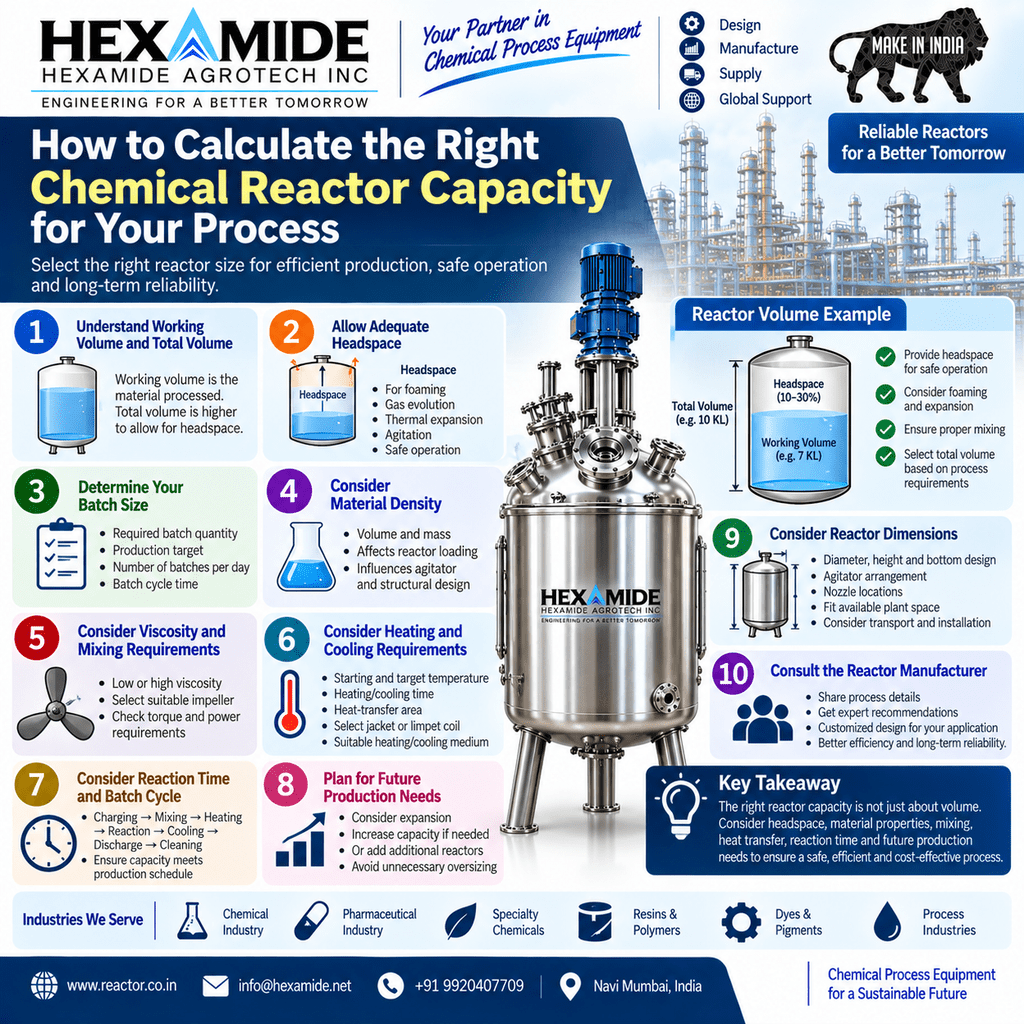
Selecting the correct chemical reactor capacity is essential for efficient and reliable production. A reactor that is too small may limit production capacity, while an unnecessarily large reactor can increase equipment cost, utility consumption, and installation requirements.
Reactor capacity should not be selected only by looking at the required batch quantity. Factors such as working volume, headspace, foaming, expansion, reaction conditions, mixing requirements, and future production requirements should also be considered.
In this guide, we explain the key factors that should be evaluated when determining the right chemical reactor capacity for your process.
1. Understand Working Volume and Total Volume
One of the most important concepts in reactor sizing is the difference between working volume and total vessel volume.
Working volume is the amount of material normally processed during a batch.
Total volume is the complete internal capacity of the reactor.
The total reactor volume is generally greater than the working volume because sufficient space may be required above the process material.
For example, a reactor may have a total capacity of 10 KL while the normal working volume is lower.
2. Allow Adequate Headspace
A reactor should not normally be filled completely to its total volume.
Headspace may be required for:
- Foaming
- Gas evolution
- Thermal expansion
- Agitation
- Reaction expansion
- Safe batch operation
The required headspace depends on the process and should be determined during the reactor design stage.
3. Determine Your Batch Size
Start by determining how much material needs to be processed in each batch.
Consider:
- Raw material quantity
- Final product quantity
- Batch density
- Production target
- Number of batches per day
- Batch cycle time
For example, if your production target requires multiple batches per day, the required reactor capacity may be different from a process operating with only one batch per day.
4. Consider Material Density
Reactor sizing should consider both volume and mass.
If the process material has a high density, the weight of the batch can be significantly higher than that of a low-density material occupying the same volume.
Material density can therefore affect:
- Reactor loading
- Agitator torque
- Motor selection
- Structural design
- Vessel support requirements
5. Consider Viscosity and Mixing Requirements
The viscosity of the product can influence reactor geometry and agitator selection.
High-viscosity products may require:
- Larger or specialized agitators
- Higher torque
- Lower operating speed
- Anchor or helical ribbon agitators
- Additional mixing considerations
Therefore, reactor capacity and agitation design should be considered together.
6. Consider Heating and Cooling Requirements
Increasing reactor capacity generally increases the quantity of material that must be heated or cooled.
The design should therefore consider:
- Starting temperature
- Target temperature
- Heating time
- Cooling time
- Heat-transfer area
- Heating medium
- Cooling medium
- Process heat generation
A jacketed or limpet coil arrangement may be selected according to the required heat-transfer duty and process conditions.
7. Consider Reaction Time and Batch Cycle
Reactor capacity is closely connected to production scheduling.
A typical batch cycle may include:
Charging → Mixing → Heating → Reaction → Cooling → Discharge → Cleaning
If the reaction requires several hours, increasing the number of batches may not always be practical.
The reactor size should therefore be evaluated against the complete batch cycle and required production output.
8. Consider Future Production Requirements
When investing in a chemical reactor, it can be useful to consider future production requirements.
If production is expected to increase, the design strategy may involve:
- Increasing reactor capacity
- Adding additional reactors
- Increasing batch frequency
- Designing equipment for future expansion
However, oversizing a reactor without a clear process requirement can also increase the initial investment and operating costs.
9. Consider Reactor Dimensions
Capacity is not only about volume.
The reactor’s:
- Diameter
- Height
- Length
- Bottom configuration
- Agitator arrangement
- Nozzle locations
- Support structure
must fit the available plant space and process requirements.
Transport, installation, maintenance access, and operating clearance should also be considered.
10. Consult the Reactor Manufacturer
Once the process information is available, an experienced chemical reactor manufacturer can evaluate the appropriate vessel capacity and configuration.
Provide information such as:
- Required batch quantity
- Material density
- Material viscosity
- Chemical composition
- Operating temperature
- Operating pressure
- Heating and cooling requirements
- Mixing requirements
- Batch cycle time
- Desired production capacity
This information helps the manufacturer develop a reactor suited to the actual process.
Example of Reactor Capacity Planning
Suppose a process requires a batch containing a specific quantity of liquid material.
Instead of simply choosing a reactor with exactly the same volume as the batch, the design should consider:
Required batch volume + headspace + process expansion + mixing requirements = appropriate total reactor capacity
The exact usable volume should be determined from the process characteristics and vessel design.
Common Mistakes in Reactor Capacity Selection
Some common mistakes include:
- Selecting a reactor based only on nominal capacity
- Ignoring headspace
- Not considering foaming
- Underestimating viscosity
- Ignoring heating and cooling requirements
- Not considering agitator torque
- Forgetting future production requirements
- Ignoring available plant space
A process-specific approach can help avoid these problems.
Conclusion
Selecting the correct chemical reactor capacity requires more than calculating the volume of material in a batch. Working volume, total volume, headspace, density, viscosity, mixing, heat transfer, reaction time, production requirements, and plant layout should all be considered.
The objective is to select a reactor that provides sufficient capacity while maintaining efficient mixing, heating, cooling, and safe operation.
Hexamide Agrotech Inc manufactures chemical reactors, stainless steel reactors, jacketed reactors, limpet coil reactors, reaction vessels, and customized process equipment based on application-specific requirements.
Chemical Reactor → Jacketed Reactor → Limpet Coil Reactor → Agitator & Impeller → Stainless Steel Reactor → Reaction Vessel